Download
1 / 14
140 likes | 275 Vues
Iraq faces significant health risks due to its deteriorating infrastructure and ongoing internal and external conflicts. The extreme climate, characterized by temperature fluctuations of 122°F by day to 37°F at night, creates hazardous living conditions. Water and food contamination, airborne dust, and vector-borne diseases pose immediate threats to health. An intermediate risk for infectious diseases, including waterborne illnesses and sexually transmitted infections, necessitates effective force health protection measures to ensure safety and mission effectiveness.

E N D
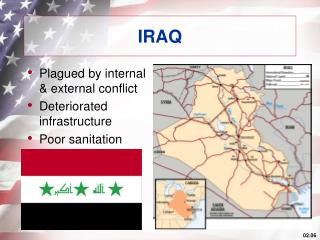
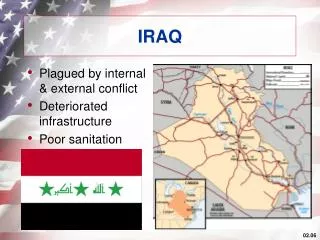
IRAQ • Plagued by internal & external conflict • Deteriorated infrastructure • Poor sanitation
Physical Environment • Topography • Broad Desert Plains • Hills • Mountains • Climate • Temp extremes • 122° F day • 37° F night Dust and sandstorms occur year-round; most severe between May and October
Environmental Health Risk • Greatest short-term health risks • Ingestion of food or water contaminated with fecal pathogens. • Extreme heat, high altitude, and airborne dust and sand • Greatest long term risks are associated with air contamination and chemical contamination of food/water
Infectious Disease Risk • INTERMEDIATE RISKfor infectious diseases • Disease risk will adversely impact mission effectiveness unless force health protection measures are implemented
Infectious Diseases • Foodborne and Waterborne Diseases • HIGH RISK = Diarrhea, hep A, typhoid fever • INTERMEDIATE RISK = brucellosis, cholera, hep E • FHP Priorities • Deploy appropriate PM personnel and equipment • Consume food, water, ice only from US-approved sources • Operate food preparation facilities in accordance with Army doctrine • Ensure proper hand washing facilities near all latrines and dining facilities and enforce
Infectious Diseases Cont. • Vector-borne Diseases • LOW RISK= Malaria, Leishmaniasis, Crimean-Congo fever, Rickettsioses, Sand-fly fever, Plague, West Nile fever • FHP Priorities • Use DEET on all exposed skin • Treat field uniforms with permethrin • Use bed nets in field conditions, treat with permethrin • Enforce malaria chemoprophylaxis as appropriate
Infectious Diseases Cont. • Animal-contact Diseases • INTERMEDIATE RISK= Avian Influenza, Anthrax, Q-fever, Rabies • FHP Priorities • Avoid animal contact • No mascots • Report all animal bites and scratches What not to do!
Infectious Diseases Cont. • Sexually Transmitted Diseases • INTERMEDIATE RISK= gonorrhea, chlamydia, HIV, Hep B • FHP Priorities • Avoid sexual contact • Use latex condoms if sexually active
Infectious Diseases Cont. • Water-contact Diseases • INTERMEDIATE RISK= leptospirosis, schistosomiasis • FHP Priorities • avoid unnecessary contact with lakes, rivers, streams, and other surface water There will not be a sign like this.
Infectious Diseases Cont. • Respiratory Diseases • INTERMEDIATE RISK= tuberculosis • FHP Priorities • Tuberculin skin test before and after deployment • Avoid close contact with local population
Hazardous Animals & Plants • Animals • Rabid animals snakes, centipedes, scorpions, spiders • Plants • Mole Plant, Belladonna, Strychnine • FHP Priorities • Do not handle animals • Shake out boots, clothing, & bedding • Do not touch, chew, eat, or burn unfamiliar plants
SUMMARY • Physical Environment • Infectious Diseases = Intermediate Risk • Hazardous Animals and Plants • FHP measures are simple and effective • Use and Enforce • Will conserve the fighting strength