
SlideServe
Menu
Préférences
© SlideServe · v2026

Estimating Sample Size and Confidence Levels for Statistical Audits in Electronic Voting

laurie avatar
20 diapositives · 328 Views · Sep 23, 2014

This paper discusses the framework for estimating the necessary sample size and confidence thresholds in statistical audits of electronic voting systems. The motivation stems from the need to ensure voter confidence and detect potential electoral fraud. The methodology includes sampling precincts and handling voter-verified paper ballots, with a focus on statistical models that dictate how many precincts to audit based on desired confidence levels. Additionally, it explores legislative considerations and the implications of audit findings on election integrity.
Estimating Sample Size and Confidence Levels for Statistical Audits in Electronic Voting - slide 1
01 / 20Estimating Sample Size and Confidence Levels for Statistical Audits in Electronic Voting
1 / 17

Télécharger la présentation

Estimating Sample Size and Confidence Levels for Statistical Audits in Electronic Voting
Une image / un lien ci-dessous est fourni (tel quel) pour télécharger la présentation

Politique de téléchargement : le contenu du site vous est fourni TEL QUEL pour votre information et votre usage personnel ; il ne peut être vendu, concédé sous licence ni partagé sur d’autres sites sans l’accord de son auteur.Le contenu vous est fourni TEL QUEL, pour votre information et votre usage personnel uniquement. Téléchargez la présentation en cliquant sur ce lien. Lors du téléchargement, si vous ne parvenez pas à télécharger une présentation, l’éditeur a peut-être supprimé le fichier de son serveur.Pendant le téléchargement, si vous ne parvenez pas à obtenir une présentation, le fichier a peut-être été supprimé par l’éditeur.

F I N

Plus de contenu associé

Transcription de la présentation
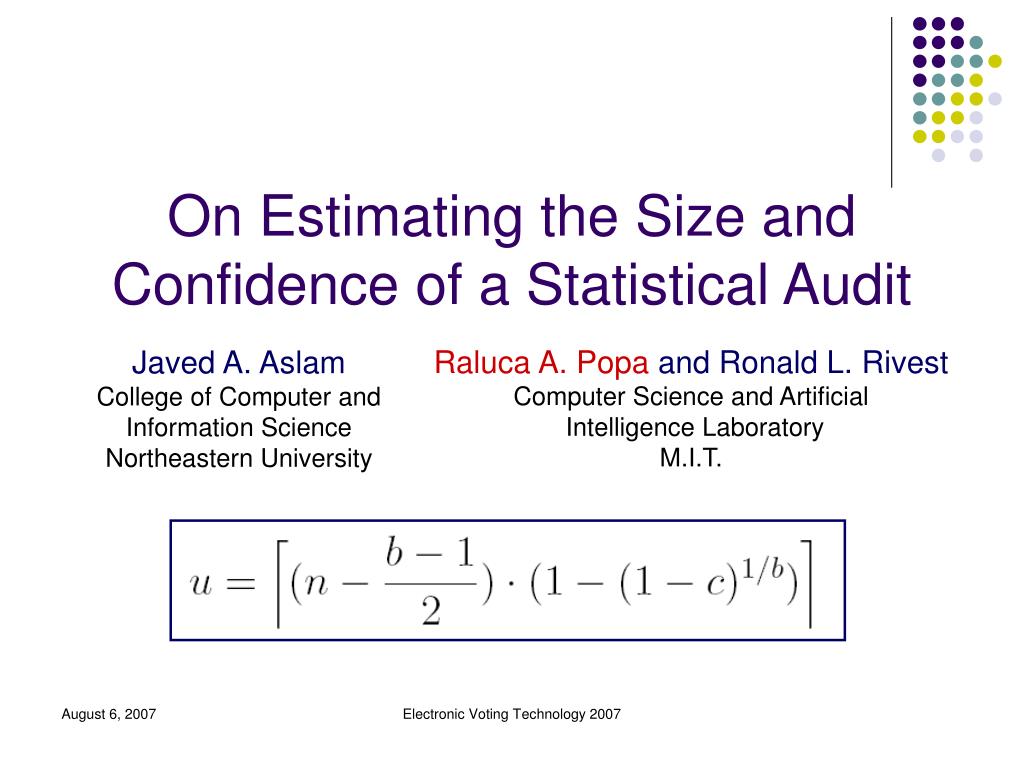
  1. On Estimating the Size and Confidence of a Statistical Audit Raluca A. Popa and Ronald L. Rivest Computer Science and Artificial Intelligence Laboratory M.I.T. Javed A. Aslam College of Computer and Information Science Northeastern University Electronic Voting Technology 2007

  2. Outline • Motivation • Background • How Do We Audit? • The Problem • Analysis • Model • Sample Size • Bounds • Conclusions Electronic Voting Technology 2007

  3. Motivation • There have been cases of electoral fraud (Gumbel’s Steal This Vote, Nation Books, 2005) • Would like to ensure confidence in elections • Auditing = comparing statistical sample of paper ballots to electronic tally • Provides confidence in a software independent manner Electronic Voting Technology 2007

  4. How Do We Audit? • Proposed Legislation: Holt Bill (2007) • Voter-verified paper ballots • Manual auditing • Granularity: Machine, Precinct, County • Procedure • Determine u, # precincts to audit, from margin of victory • Sample u precincts randomly • Compare hand count of paper ballots to electronic tally in sampled precincts • If all are sufficiently close, declare electronic result final • If any are significantly different, investigate! Electronic Voting Technology 2007

  5. How Do We Audit? • Proposed Legislation: Holt Bill (2007) • Voter-verified paper ballots • Manual auditing • Granularity: Machine, Precinct, County • Procedure • Determine u, # precincts to audit, from margin of victory • Sample u precincts randomly • Compare hand count of paper ballots to electronic tally in sampled precincts Our formulas are independent of the auditing procedure Electronic Voting Technology 2007

  6. The Problem • How many precincts should one audit to ensure high confidence in an election result? Electronic Voting Technology 2007

  7. Previous Work • Saltman (1975): The first to study auditing by sampling without replacement • Dopp and Stenger (2006): Choosing appropriate audit sizes • Alvarez et al. (2005): Study of real case auditing of punch-card machines Electronic Voting Technology 2007

  8. Hypothesis Testing • Null hypothesis: The reported election outcome is incorrect (electronic tally indicates different winner than paper ballots) • Want to reject the null hypothesis • Need to sample enough precincts to ensure that, if no fraud is detected, the election outcome is correct with high confidence Electronic Voting Technology 2007

  9. Model n precincts b corrupted (“bad”) • c = desired confidence • Want: If there are ≥ b corrupted precincts, then sample contains at least one with probability ≥ c • Equivalently: If the sample contains no corrupted precincts, then the election outcome is correct with probability ≥ c • Typical values: n = 400, b = 50, c = 95% Sample u precincts (without replacement) Electronic Voting Technology 2007

  10. What isb? • Minimum # of precincts adversary must corrupt to change election outcome • Derived from margin of victory • Our formulas are independent of b’s calculation b = (half margin of victory) · n margin [times 5 (Dopp and Stenger, 2006)] Electronic Voting Technology 2007

  11. Rule of Three • If we draw a sample of size ≥3n/bwith replacement, then: • Expect to see at least three corrupted precincts • Will see at least one corrupted precinct with c ≥ 95% • In practice, we sample without replacement (no repeated precincts) Electronic Voting Technology 2007

  12. Sample Size • Probability that no corrupted precinct is detected: • Optimal Sample Size: Minimum u such that Pr≤ 1- c Pr =﴾﴿/ ﴾﴿ n-b u n u Problem: Need a computer • Goal: Derive a simple and accurate upper bound that an election official can compute on a hand-held calculator Electronic Voting Technology 2007

  13. Our Bounds • Intuition: How many different precincts are sampled by the Rule of Three? • Our without replacement upper bounds: A C C U R A C Y Electronic Voting Technology 2007

  14. Our Bounds • Intuition: How many different precincts are sampled by the Rule of Three? • Our without replacement upper bounds: • Example: n = 400, b = 50 (margin=5%), c = 95% Electronic Voting Technology 2007

  15. Our Bound • Conservative: provably an upper bound • Accurate: • For n≤10,000, b ≤ n/2, c ≤ 0.99 (steps of 0.01): • 99% is exact, 1% overestimates by 1 precinct • Analytically, it overestimates by at most –ln(1-c)/2, e.g. three precincts for c< 0.9975 • Can be computed on a hand-held calculator Electronic Voting Technology 2007

  16. Observations Precincts to Audit n = 400, c=95% 1% 20% Margin of Victory 10% 1% • Fixed level of auditing is not appropriate Electronic Voting Technology 2007

  17. Observations (cont’d) Precincts to Audit n = 400, c=65% Holt Tier 20% Margin of Victory 10% 1% 2% • Holt Bill (2007): Tiered auditing Electronic Voting Technology 2007

  18. Related Problems • Inverse questions • Estimate confidence level c from u,b, and n • Estimate detectable fraud level b from u, c, and n • Auditing with constraints • Holt Bill (2007): Audit at least one precinct in each county • Future work • Handling precincts of variable sizes (Stanislevic, 2006) Electronic Voting Technology 2007

  19. Conclusions • We develop a formula for the sample size: that is: • Conservative (an upper bound) • Accurate • Simple, easy to compute on a pocket calculator • Applicable to different other settings Electronic Voting Technology 2007

  20. Thank you! • Questions? Electronic Voting Technology 2007