Estimating Confidence Intervals
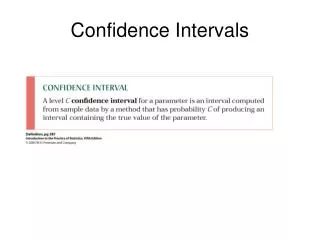
This introduction to confidence intervals explores the estimation of success probabilities in binomial distributions. Given a fixed number of trials (n = 1000) and observed successes (r = 550), we calculate probabilities for success (P(Success) = 0.55) and failure (P(Failure) = 0.45). Using sample data, we illustrate the concept of confidence intervals with real-world examples. The chapter covers three scenarios for estimating confidence intervals: when the population probability is known, unknown, and specifically for binomial distributions. Discover the implications of varying confidence levels on estimation accuracy.

Estimating Confidence Intervals
E N D
Presentation Transcript
Estimating Confidence Intervals Intro to Unit 8: Estimate
Binomial Distribution? • Fixed Number of Trials? (n) 1000 • Two possibilities? • Success = favor candidate • Failure = don’t • Number of successes? (r) 550 • P(Success) = 550/1000 = .55 • P(Failure) = • .45 We use here since we don’t know the ENTIRE POPULATION
Archer hits bull's-eye 19 of every 20 times. n = 20 r = 19
IDEA: Here are 20 samples. For 20 samples, the horizontal line represents the 95% confidence interval. The vertical mark represents the for that particular sample. Notice only ONE of the 20 Confidence intervals almost fails to contain the ACTUAL p for the population.
The big problem: is an ESTIMATE for p ! (We used a SAMPLE, remember, not the POPULATION. This means that we are probably “off” a little bit and will need to account for error. Math happens
The wider the confidence interval: say 99% vs 95%, the less “sure” you can be about estimating the value you are looking for.
In this chapter, we will be estimating confidence intervals for three different situations: Situation 1: Estimating when you know Situation 2: Estimating when you DON’T know Situation 3: Estimating p for a binomial distribution