Updates on DPEHiggs Generator and Challenges in Diffractive Physics Triggering
50 likes | 166 Vues
Creighton Hogg discusses recent interactions with Roman Ryutin regarding the DPEHiggs generator's current cmkin-packaged version, revealing it is flawed but less so than initially believed. A new version was released but not yet tested. Notably, the Higgs mass peak displays a sharp width of only a few MeV. There are issues with the z-momentum loss of incoming protons and an excessive skew in the Higgs eta distribution. Solutions may require adjustments to dijet triggers and improved b-tagging techniques to preserve the signal amid high background rates.


Updates on DPEHiggs Generator and Challenges in Diffractive Physics Triggering
E N D
Presentation Transcript
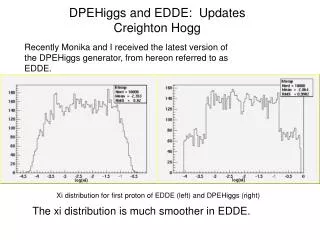
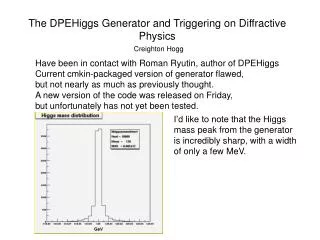
The DPEHiggs Generator and Triggering on Diffractive Physics Creighton Hogg Have been in contact with Roman Ryutin, author of DPEHiggs Current cmkin-packaged version of generator flawed, but not nearly as much as previously thought. A new version of the code was released on Friday, but unfortunately has not yet been tested. I’d like to note that the Higgs mass peak from the generator is incredibly sharp, with a width of only a few MeV.
Here and in other cases, χ is the fractional z-momentum loss of one of the incoming protons. The problem here is that there are too many events with χ nearly 1 for one of the protons. This translates into Higgs z-momentum of several TeV. Roman Ryutin has stated that this is a problem with the generation of χ. It is correct however for the Higgs to regularly have momenta of 700-800 GeV.
The Higgs eta distribution is excessively skewed to high η. However there should actually be some such skewing. We can see even in this extreme case that the extremely high pz of the Higgs does not necessarily put the b-quarks out of the detector. The η distribution of the b-quarks needs to be checked with fixed version. Currently it shows that |η| cuts of 2.5 would lose far too much of the signal.
It seems that this plot of the pt for the b-quarks is not unreasonable. This should be mostly independent of the χ issue. It’s clear though that in order to preserve much of the signal a dijet trigger would have to cut on ~40 GeV.
Considering the integrated QCD background rates with our previous cut of Ht/(Two Jet Et) < 1.1 already considered we can see that triggering on a 40 GeV dijet trigger is unfeasible even when requiring the top two jets to be extremely central. Again, b-tagging may improve the situation.