Enhancing Sentence Structure: Addressing EEVPA Problems in Writing
This lesson focuses on common issues within the EEVPA framework regarding sentence structure. We will explore the components that make up simple and compound sentences, providing clear definitions and examples. After identifying the problems in writing, such as lack of flavor in a school lunch, the lesson will guide students toward potential solutions. By encouraging critical reflection on the food quality within school meals, we aim to inspire students to articulate their thoughts more effectively and suggest improvements.

Enhancing Sentence Structure: Addressing EEVPA Problems in Writing
E N D
Presentation Transcript
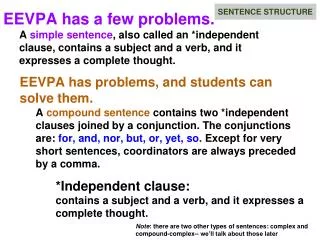
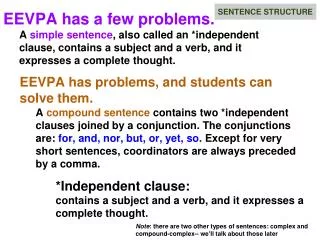
SENTENCE STRUCTURE EEVPA has a few problems. A simple sentence, also called an *independent clause, contains a subject and a verb, and it expresses a complete thought. EEVPA has problems, and students can solve them. A compound sentence contains two *independent clauses joined by a conjunction. The conjunctions are: for, and, nor, but, or, yet, so. Except for very short sentences, coordinators are always preceded by a comma. *Independent clause: contains a subject and a verb, and it expresses a complete thought. Note: there are two other types of sentences: complex and compound-complex-- we’ll talk about those later
Outline 1: Issue: Nasty Food 2: Riblets: sauce, meat not fresh, sauce was not good 3: Chicken nuggets did not have any flavor 4: Serve restaurant food (subway, burger king, etc.) 5: Push the reader to reflect on the food at their school, plant a seed OUTLINE: 1:Introduction: Identify the issue you want to discuss • Hook • Background info • Thesis: A problem at our school is_____, a solution is_______ 2: Example 1 provides evidence that the problem exists 3: Example 2 provides additional evidence that the problem exists 4: Solution: discuss a possible solution 5: Conclusion: wrap it up , give the reader something to think about Title your doc: Name_ ELA Final_Hr Highlight 1 compund sentence in each of your paragraphs