Voting Rights in U.S. History: Successes and Challenges for African Americans
240 likes | 387 Vues
This overview explores the historical challenges faced by African Americans in achieving voting rights in the United States. Key obstacles included literacy tests and poll taxes, which disproportionately affected Black voters. The Mississippi Freedom Democratic Party emerged in 1964 to advocate for voting rights. Despite violent confrontations, the Selma march led to significant legislative changes like the Voting Rights Act of 1965, prohibiting discriminatory practices. The legacy of civil rights leaders, the impact of violent riots, and ongoing debates surrounding affirmative action illustrate the complexities of race and politics in America.


Voting Rights in U.S. History: Successes and Challenges for African Americans
E N D
Presentation Transcript
More Successes and Challenges US History 14-3 Mrs. Huston
Voting Rights • Literacy Tests—make people prove they can read • Blacks were required to read very difficult material—law books, etc. • Poll Taxes—make people pay a fee to be able to vote • Blacks were often required to pay more than they could afford
Results • Together with intimidation, Literacy tests and Poll Taxes kept many blacks from voting • In Mississippi in 1964 NO African Americans were registered to vote
Freedom Summer • Plan to register blacks to vote • 1,000 volunteers • Formed a new political party—Mississippi Freedom Democratic Party
Disappearances • Three civil rights workers vanished almost immediately • SNCC claimed they’d been murdered, but the state denied it • President Johnson ordered an investigation • Bodies were found buried in an earthen dam • All had been shot
Political Party • The Mississippi Freedom Democratic Party sent a delegation to the Democratic Convention in 1964 • Fannie Lou Hamer gave a moving speech about the beatings, etc. they’d suffered to be able to vote • The Democratic Party would only give them two “at-large” seats at the convention
Convention, cont. • The MFDP refused the compromise offer • The regular Mississippi delegation walked out because the MFDP had been offered the two seats
Selma March 1965 • Organized by Martin Luther King, Jr. and the SCLC • Confrontations on Pettus Bridge • “Bloody Sunday” • Marchers attacked by state troopers and others • Nation reacted in anger
President steps in • President Johnson called for new federal voting rights law • He said it was wrong to deny any of our fellow citizens the right to vote
Voting Rights Act of 1965 • Banned literacy tests • Gave the federal government the power to oversee voting registration and elections • 1975—Hispanics in the Southwest were added to the coverage
24th Amendment • Ratified in 1964 • Banned poll tax • Supreme Court also gave several important decisions • Baker v. Carr • Reynolds v. Simms • To limit racial gerrymandering (altering district boundaries to weaken minority power)
Impact • African American political participation grew enormously • Example: in Mississippi the percentage of African American’s registered to vote went from 7% to nearly 70% over the next 20 years • The number of elected African American officials also grew
Violence • Many African Americans were still frustrated by the lack of progress • Racially based riots occurred in many large cities • Watts riot in Los Angeles • Looting • Arson • Newark, New Jersey • Detroit, Michigan
Kerner Commission • Research the reason behind the riots • Cause found to be the long term racial discrimination • Recommended programs aimed at overcoming the problems of urban ghettos • President Johnson distracted by the Vietnam War and didn’t address the issue
New Leaders Emerged • Many young, urban blacks looked for new leadership • They wanted a new approach • New methods
Individuals and Groups • Malcom X • Adopted the X to represent his lost African name • Converted to the Nation of Islam • Later broke from that group and formed his own • Shot and killed in 1965
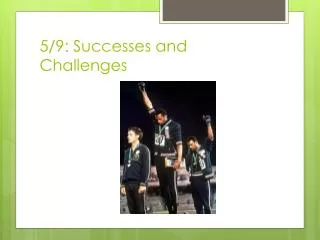
More • Stokely Carmichael • SNCC leader • First to use the term “black power” • Black Panthers • Huey Newton • Bobby Seale • Militant group • Organized armed patrols in neighborhoods for protection from police
National Attention • Marched on California state capitol • Preferred the term “black” to Negro or colored • Often in violent confrontations with police
Assassination • MLK disagreed with the call for black power • Supported non-violence • Helping sanitation workers striking for better wages in Memphis, Tennessee • Killed on the balcony of his motel April 4, 1968 • James Earl Ray was charged with his murder
Another Death • While campaigning for President, Robert F. Kennedy was assassinated in Los Angeles two months later
Civil Rights Gains • Eliminated laws promoting segregation • Knocked down barriers to voting rights • African American poverty rates fell • Average income and high school graduation rates rose
More Gains • Thurgood Marshall became the first African American Supreme Court Justice in 1967 • Fair Housing Act passed • Banned discrimination in housing
Controversies • In order to integrate schools, federal government had to order busing of students • Affirmative action laws passed • Increased African American representation in schools, businesses, etc. • The debate continued