Exploring Ancient Egypt: The Gift of the Nile and Its Dynasties
Discover the fascinating history of Ancient Egypt, which flourished around the Nile River, termed by Herodotus as "the gift of the Nile." Spanning 4000 miles from south to north, the Nile shaped Egypt’s civilization. This overview explores three major dynastic periods: the Old Kingdom, known for the iconic pyramids; the Middle Kingdom, marked by uncertainty; and the New Kingdom, featuring powerful pharaohs like Akhenaton. The art and culture of Egypt reflected its theocratic nature, polytheism, and continuity over millennia, with notable artistic expressions and monumental architecture that remain a testament to its rich legacy.

Exploring Ancient Egypt: The Gift of the Nile and Its Dynasties
E N D
Presentation Transcript
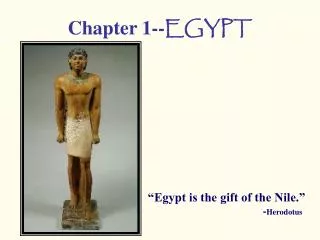
Chapter 1--EGYPT “Egypt is the gift of the Nile.” -Herodotus
Nile River flows from the south to north extending 4000 miles;therefore the Nile Delta is the Lower Nile
EGYPTIAN DYNASTIES Old Kingdom 2700-1990 BCE Confident period until 2200 conflicts Middle Kingdom 1990-1575 Ever-growing uncertainty about future New Kingdom 1575-1100 Akhenaton (1379-62) Late Period 1100-500Persians in charge
Egyptian Society and Art Parallels betweenculture and artistic expression: • Pyramidal • Static • Traditional • Other worldly • Autocratic • Unity and continuity • Polytheistic with Amon, Re, Ra, Aten (various names for the Sun god) N.B. Exception: Akhenaton and the El Amarna experiment • Osiris—ruler of the underworld • Resurrection central for the gods, pharaoh, and commoners • Theocracy with the pharaoh as god’s representative (You will need to be able to compare and contrast these characteristics with the Greeks)
Votive palette of King Narmer (Menes) 3100 BCE(first pharaoh who united Upper and Lower Egypt)
N.B. left foot forward, arms by side, and smile (only the smile will change over the centuries) Ca. 2515 BCE
N.B. the way the body is painted: head and legs painted side forwards and torso painted frontal while the eye looks at viewer
And now for a moment of Zen: The Egyptians had nearly 3,000 years of centralized societal control without producing any artistic growth or new ideas.
For an interesting world timeline: http://www.metmuseum.org/toah/hm/03/hm03.htm