Single Replacement
This guide explores the concepts of single and double replacement reactions in chemistry. Single replacement reactions involve one element replacing a similar element in a compound, represented by the equation A + BX → AX + B, where reactive metals can replace less reactive ones and halogens can replace other halogens. Double replacement reactions occur when ions from two compounds exchange places, as shown in the generalized equation AX + BY → AY + BX. These reactions are often evidenced by the formation of a precipitate or gas. Practice problems are included for better understanding.


Single Replacement
E N D
Presentation Transcript
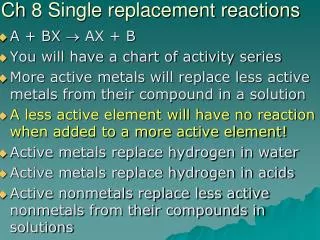
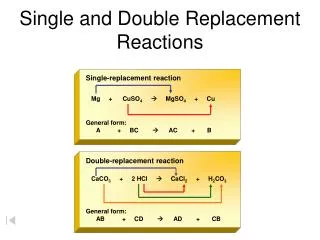
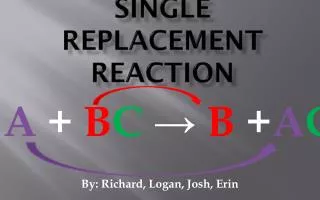
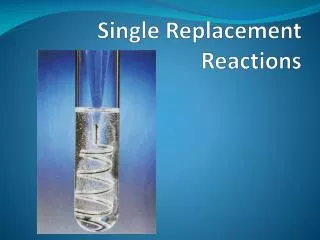
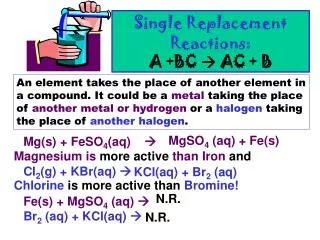
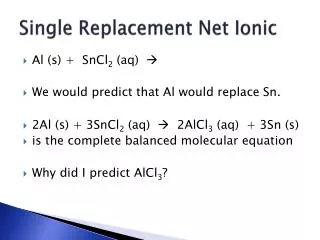
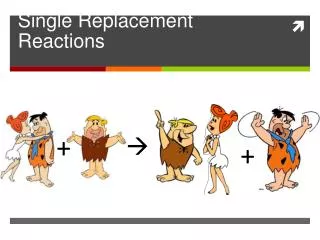
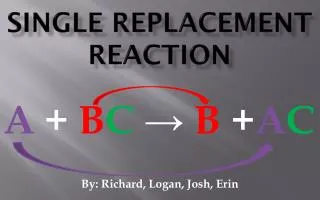
Single Replacement • One element replaces a similar element in a compound • A + BX → AX + B • A replaces B if A and B are similar • Metals can replace less reactive metals Al + Fe(NO3) → Al(NO3)+ Fe
Metals can replace H Mg + HCl → MgCl2 + H2 Na + H2O → NaOH + H2
Halogens can replace other halogens Br2 + KCl → KBr + Cl2
Single Replacement Reactions • Al + Cu(NO3)2 • NaCl + F2 • K + H2O • Na + Mg(OH)2 • Ni + FeSO4
Double Replacement • Ions of two compounds exchange places AX + BY → AY + BX Double Replacement reactions are often evidenced be the formation of a precipitate or the production of a gas
Practice • HCl(aq) + AgNO3(aq) • CaCl2(aq) + Na3PO4(aq) • Pb(NO3)2(aq) + BaCl2(aq) • FeCl3(aq) + NaOH(aq) • H2SO4(aq) + NaOH(aq) • KOH(aq) + CuSO4(aq)
Mixed Practice State the type, predict the products, and balance the following reactions: • BaCl2 + H2SO4 • C6H12 + O2 • Zn + CuSO4 • Cs + Br2 • FeCO3