SlideServe
Menu
Préférences
© SlideServe · v2026

Single Replacement Reactions

sadah avatar
18 diapositives · 500 Views · Sep 01, 2014

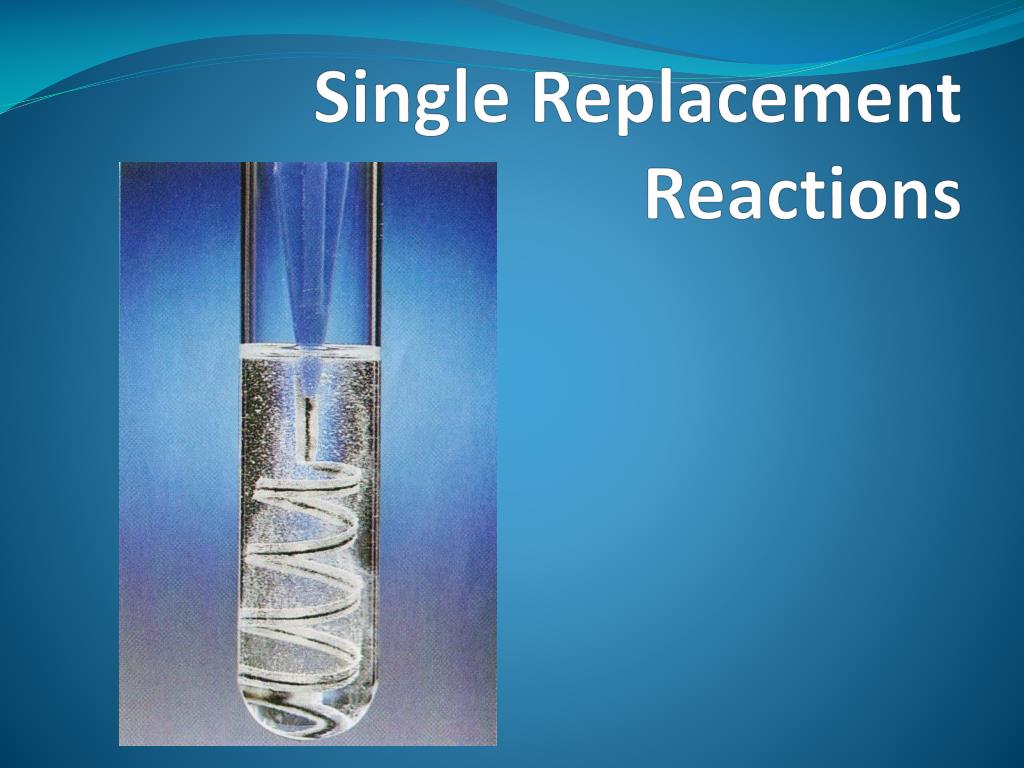
Single Replacement Reactions. Steps to Writing Reactions. Some steps for doing reactions Identify the type of reaction Predict the product(s) of the reaction Write the correct formula of the compounds Balance the equation. Seven Diatomic elements. Have No Fear Of Ice Cold Beer!
Single Replacement Reactions - slide 1
01 / 18Single Replacement Reactions
1 / 17

Télécharger la présentation

Single Replacement Reactions
Une image / un lien ci-dessous est fourni (tel quel) pour télécharger la présentation

Politique de téléchargement : le contenu du site vous est fourni TEL QUEL pour votre information et votre usage personnel ; il ne peut être vendu, concédé sous licence ni partagé sur d’autres sites sans l’accord de son auteur.Le contenu vous est fourni TEL QUEL, pour votre information et votre usage personnel uniquement. Téléchargez la présentation en cliquant sur ce lien. Lors du téléchargement, si vous ne parvenez pas à télécharger une présentation, l’éditeur a peut-être supprimé le fichier de son serveur.Pendant le téléchargement, si vous ne parvenez pas à obtenir une présentation, le fichier a peut-être été supprimé par l’éditeur.

F I N

Plus de contenu associé

Transcription de la présentation
  1. Single Replacement Reactions

  2. Steps to Writing Reactions • Some steps for doing reactions • Identify the type of reaction • Predict the product(s) of the reaction • Write the correct formula of the compounds • Balance the equation

  3. Seven Diatomic elements Have No Fear Of Ice Cold Beer! For example, Oxygen is O2 as anelement. H2, N2, F2, O2, I2, Cl2, Br2 Memorize this list!

  4. Notation used to show physical state of substances: • (s) solid, such as metals • (l) liquid, like water! • (g) gas, like hydrogen • (aq) aqueous, dissolved in water Memorize these!

  5. Single replacement reactions

  6. Single Replacement Reactions • Single Replacement Reactions occur when one element replaces another in a compound. A metal can replace a metal (the positive ions trade places) OR a nonmetal can replace a nonmetal (the negative ion trades). • element + compound element + compound A + BY  AY + B (if A is a metal) OR X + BY  BX + Y (if X is a nonmetal) (remember the cation always goes first!)

  7. Activity Series:

  8. Single Replacement Reactions

  9. Single Replacement Reactions • Write and balance the following single replacement reaction equation: • Zinc metal reacts with aqueous hydrochloric acid Zn(s) + HCl(aq) ZnCl2(aq) + H2(g) Note: Zinc replaces the hydrogen ion in the reaction 2

  10. Single Replacement Reactions 2 2 Sodium bromide solid reacts with chlorine gas NaBr(aq) + Cl2(g)  NaCl(aq) + Br2(l) Note that chlorine replaces bromine in the compound • Aluminum metal reacts with aqueous copper (II) nitrate Al(s)+ Cu(NO3)2(aq) Copper DOES NOT reaction with aqueous aluminum nitrate. Copper is below aluminum on the activity series. Cu(s)+ Al(NO3)3(aq) No Reaction

  11. Alkali metals and alkaline earth metals: Most react with acid solutions to produce a salt and hydrogen gas. Ex: Mg(s) + HCl(aq) MgCl2 + H2(g) You try: Li(s) + H2SO4(aq)  Memorize the following acids: hydrochloric acid HCl Sulfuric acid H2SO4 Nitric acid HNO3 Phosphoric acid H3PO4

  12. Alkali metals and alkaline earth metals • Many of them are active metals that react with water and produce a base and hydrogen gas: Ex: 2 Li(s) + 2 H2O(l) 2 LiOH(aq) + H2(g) Hint: Water is HOH! You try: Ca(s) + HOH(l) 

  13. Alkali Metals and Alkaline Earth metals Active metals replace the metallic ions in solution to produce a salt and the other metal. Ex: Mg(s) + CuCl2(aq) MgCl2(aq) + Cu(s) Your turn: Mg(s) + ZnCl2(aq)

  14. Halogens: • More active halogens replace less active halides in single replacement reactions. F > Cl > Br > I (The same order as the periodic table) Example: MgBr2(s) + Cl2(g)  MgCl2(s) + Br2(l) Try: NaBr(s) + I2(g)  NO REACTION!

  15. Practice • Mg(s) + H2SO4(aq) • Au(s) + HCl(aq)  • Zn(s) + CuSO4(aq)  • Cl2(aq) + CaBr2(aq)  • Fe(s) + HNO3(aq)  • Na(s) + H2O(l) 

  16. Answers: Check your work! • Mg(s) + H2SO4(aq) MgSO4(aq)+ H2(g) • Au(s) + HCl(aq)  No reaction • Zn(s) + CuSO4(aq)  Cu(s) + ZnSO4(aq) • Cl2(aq) + CaBr2(aq)  Br2(aq) + CaCl2(aq) • Fe(s) + 2 HNO3(aq)  H2(g) + Fe(NO3)2(aq) • 2 Na(s) + 2 H2O(l)  2 NaOH(aq) + H2(g)

  17. More practice – answers on the next slide. • Al(s) + H2SO4(aq) • Ca(s) + HCl(aq)  • Cu(s) + ZnSO4(aq)  • F2(aq) + LiBr(aq)  • Mg(s) + HNO3(aq)  • Ca(s) + H2O(l)  • Cl2(aq) + AlBr3(aq) 

  18. 2Al(s) + 3 H2SO4(aq) 2 H2 (g) + Al2(SO4)3(aq) • Ca(s) + 2 HCl(aq)  CaCl2(aq) + H2(g) • Cu(s) + ZnSO4(aq)  no reaction • F2(aq) + LiBr(aq)  LiF(aq) + Br2(aq) • Mg(s) +2 HNO3(aq)  Mg(NO3)2(aq) + H2(g) • Ca(s) + 2 H2O(l)  Ca(OH)2(aq) + H2(g) • Cl2(aq) + AlBr3(aq)  AlCl3(s) + Br2(aq)