Replacement Reactions
This educational resource covers the four primary types of chemical reactions—synthesis, decomposition, single-replacement, and double-replacement. Learn how single-replacement reactions occur when an uncombined element replaces an element in a compound, illustrated by examples like zinc reacting with hydrochloric acid. The guide also explains double-replacement reactions, where two compounds interact to generate two new compounds. Ideal for students exploring physical science, this summary provides clarity on key concepts in chemical reactions.

Replacement Reactions
E N D
Presentation Transcript
Replacement Reactions Mr. Skirbst Physical Science Topic 17
4 Types of Chemical Reactions 1. SYNTHESIS 2. DECOMPOSITION
4 Types of Chemical Reactions 3. SINGLE-REPLACEMENT
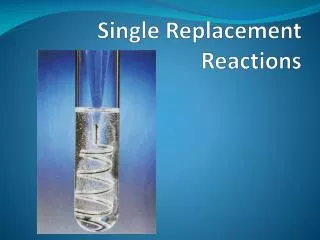
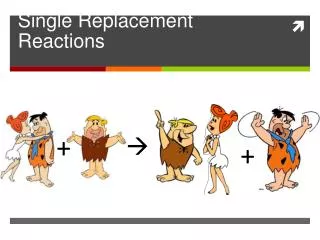
4 Types of Chemical Reactions • SINGLE-REPLACEMENT - an uncombined element replaces an element in a compound
4 Types of Chemical Reactions • SINGLE-REPLACEMENT - General Format: A + BX AX + B ie. Zn + HCl ZnCl + H2
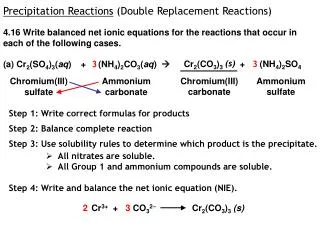
4 Types of Chemical Reactions 4. DOUBLE-REPLACEMENT - two compounds react to form two new compounds
4 Types of Chemical Reactions 4. DOUBLE-REPLACEMENT - General Format: AX + BY AY + BX NaHCO3 + HC2H3O2 NaC2H3O3 + H2CO3