Replacement Reactions
This guide explores single and double replacement reactions, where elements or ions in compounds exchange places. In single replacement reactions, a more reactive element displaces a less reactive one (A + BX → AX + B). Examples include metals replacing less reactive metals and halogens replacing other halogens. Double replacement reactions involve the exchange of ions between two compounds (AX + BY → AY + BX), often resulting in a precipitate or gas. Practice problems are included to reinforce understanding and predict products while balancing reactions.

Replacement Reactions
E N D
Presentation Transcript
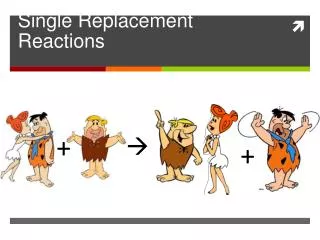
Single Replacement • One element replaces a similar element in a compound • A + BX → AX + B • A replaces B if A and B are similar • Metals can replace less reactive metals Al + Fe(NO3) → Al(NO3)+ Fe
Metals can replace H Mg + HCl → MgCl2 + H2 Na + H2O → NaOH + H2
Halogens can replace other halogens Br2 + KCl → KBr + Cl2
Single Replacement Reactions • Al + Cu(NO3)2 • NaCl + F2 • K + H2O • Na + Mg(OH)2 • Ni + FeSO4
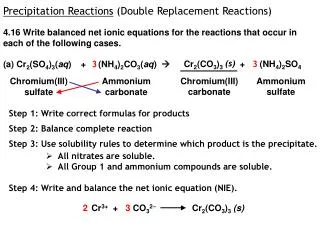
Double Replacement • Ions of two compounds exchange places AX + BY → AY + BX Double Replacement reactions are often evidenced be the formation of a precipitate or the production of a gas
Practice • HCl + AgNO3 • CaCl2 + Na3PO4 • Pb(NO3)2 + BaCl2 • FeCl3 + NaOH • H2SO4+ NaOH • KOH + CuSO4
Mixed Practice State the type, predict the products, and balance the following reactions: • BaCl2 + H2SO4 • C6H12 + O2 • Zn + CuSO4 • Cs + Br2 • FeCO3