Download
1 / 5
50 likes | 174 Vues
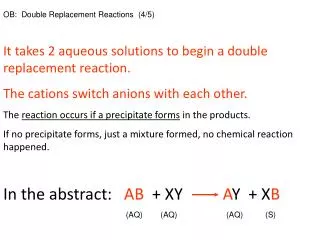
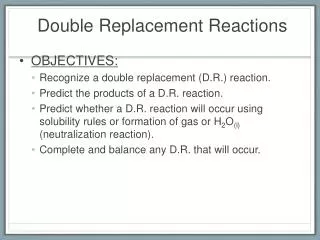
Double replacement reactions require a driving force to occur, transforming reactants into products instead of remaining as a mixture. The driving forces include the formation of a precipitate, gas, or a molecular compound. For example, when silver nitrate reacts with lithium bromide, silver bromide precipitates. Similarly, hydrochloric acid reacting with potassium sulfite produces sulfur dioxide gas. Analyzing the solubility of reactants helps in predicting precipitate formation. The net ionic equation simplifies the reaction process, highlighting key species that participate in the chemical change.

E N D
Double Replacement Reactions Cation exchange
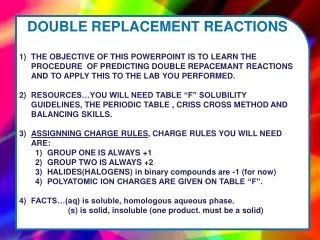
Driving Force – Two compounds • There must be a driving force for the reaction to take place, otherwise it will remain as a mixture. Driving Forces: • Formation of a precipitate (ppt) • Formation of a gas • Formations of a molecular compound
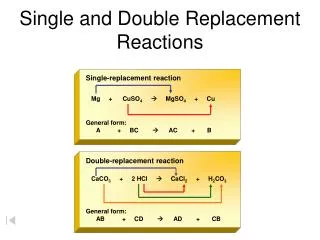
Examples • Formation of a ppt Ag NO3 + LiBr • Ag+ + Br -AgBr • Formation of a gas HCl + K2SO3 • H+ + SO32- H2O + SO2 • Formation of a molecular compound HF + SiO2 • HF + SiO2 H2O + SiF4
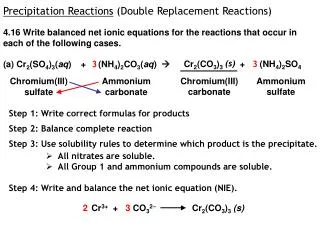
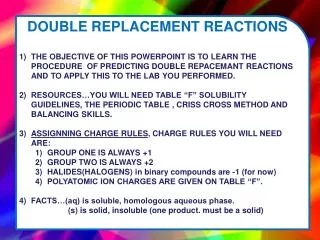
Formation of a ppt – net ionic • Determine if the reactants are soluble or insoluble. Soluble – separate into ions, insoluble – keep together. • Determine the driving force….which combination of species forms a ppt. • Write products with precipitates together and solubles as separated. • Cross out species that appear exactly the same on both sides of the equation. • Write the Balanced Equation with what remains
Example • Copper (II) sulfate is added to sodium sulfide CuSO4 + Na2S CuS + Na2SO4 Cu2+ + SO42- + 2Na+ + S2-CuS + 2Na+ + SO42- Net Ionic Equation Cu2++ S2-CuS