Understanding Double Replacement Reactions in Aqueous Solutions
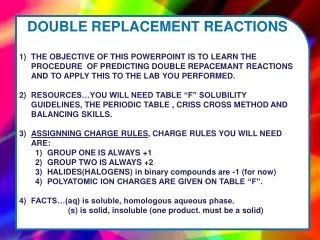
Double replacement reactions occur when two ionic compounds are mixed in aqueous solutions, leading to the formation of products such as liquids, gases, or solids. The behavior of substances in water depends on their nature—ionic compounds dissociate into ions, while covalent compounds like sugar remain intact. This guide explores the processes involved, including complete and net ionic equations, and how to identify the solubility of products using reference tables. Key examples illustrate reactions producing water, gases, and solids, emphasizing the conservation of charge throughout the reactions.

Understanding Double Replacement Reactions in Aqueous Solutions
E N D
Presentation Transcript
DR rxns occur in aqueous solutions • What happens when substances dissolve in water? • depends if substance is ionic or covalent
Dissolving • covalent substances (such as sugar can dissolve but molecules stay intact in solution) • C6H12O6(s) C6H12O6(aq) • covalent substances: moleculesspread out in solution
Dissolving • Ionic substances ionize (dissociate) when dissolve; molecules do not remain intact • NaCl(s) Na+1(aq) + Cl-1(aq) • Ionic substances: ions spread out in solution
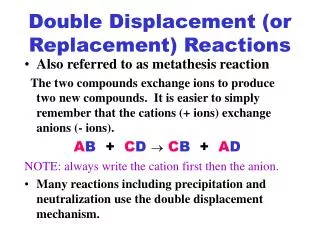
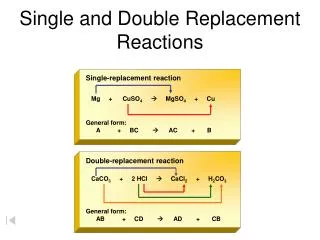
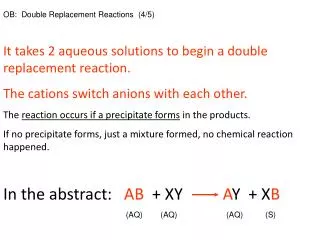
Double Replacement Reactions • occur when mix 2 ionic compounds together in an aqueous soln • 3 possible products: - liquid (H2O) - gas - solid
Reactions that form liquid water HBr(aq) + NaOH(aq) H2O(l) + NaBr(aq) aqueous refers to something dissolved in water so when water is a product it is labeled as liquid NOT aqueous
H2O(l) + CO2(g) Reactions that form Gases HCl(aq) + NaHCO3(aq) H2CO3(aq) + NaCl(aq) HCl(aq) + NaHCO3(aq) H2O(l) + CO2(g) + NaCl(aq)
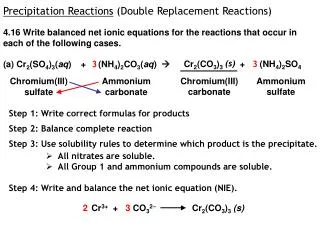
Reactions producing Solids 2 NaOH(aq) + CuCl2(aq) 2 NaCl(aq) + Cu(OH)2(s)
Reactions producing Solids Precipitation reactions: • occur when an insoluble solid is formed as a result of chemical reaction solid precipitate forms - opposite of dissolving!
So how do you know if a product of a DR reaction is aqueous or a solid, liquid or gas? Table F is used to determine if a product is soluble or not If soluble: (aq) If not soluble: (s)
Complete Ionic Equations and Net Ionic Equations
Complete Ionic Equations show all ions involved in a chemical reaction taking place in aqueous solution
Ex: Complete Ionic Equation NaOH(aq) + CuCl2(aq) 2 NaCl(aq) + Cu(OH)2(s) Na+1(aq) + 2OH-1(aq) + Cu2+(aq) + 2Cl-1(aq) 2Na+1(aq) + 2Cl-1(aq) + Cu(OH)2(s)
Net Ionic Equationsshow only the ions that form a non-aqueous product in a DR chemical reaction
Net ionic equation: 2OH-1(aq) + Cu2+(aq) Cu(OH)2(s) Solid as product Complete ionic equation: 2Na+1(aq) + 2OH-1(aq) + Cu2+(aq) + 2Cl-1(aq) 2Na+1(aq) + 2Cl-1(aq) + Cu(OH)2(s) • Notice some ions do not participate in reaction • known as spectator ions • cross out spectator ions to get net ionic equation
Net ionic equation: H+1(aq) + OH-1(aq) H2O(l) Water as product HBr(aq) + NaOH(aq) H2O(l) + NaBr(aq) Complete ionic equation: H+1(aq) + Br-1(aq) + Na+1(aq) + OH-1(aq) H2O(l) + Na+1(aq) + Br-1(aq)
Net ionic equation: H+1(aq) + HCO3-1(aq) H2O(l) + CO2(g) Gases as product HCl(aq) + NaHCO3(aq) H2O(l) + CO2(g) + NaCl(aq) Complete ionic equation: H+1(aq) + Cl-1(aq) + Na+1(aq) + HCO3-1(aq) H2O(l) + CO2(g) + Na+1(aq) + Cl-1(aq)
Conservation of Charge total charge (reactant side) must = total charge on product side