Populations and Sampling
This article explores the concepts of populations, sampling, and various sampling methods used in surveys. A population is defined as a group of people about whom information is needed, while a census involves collecting data from every individual in that population. We differentiate between sampling methods such as simple random sampling, stratified sampling, systematic sampling, quota sampling, cluster sampling, and convenience sampling. The selection of an appropriate sample size and method is crucial for obtaining reliable and unbiased results, considering factors like time, cost, and variability in the population.

Populations and Sampling
E N D
Presentation Transcript
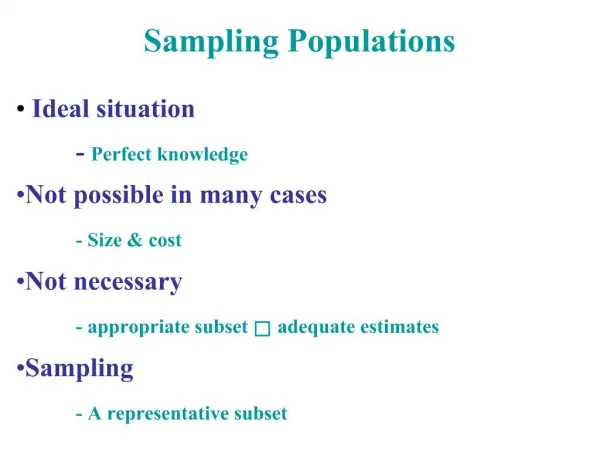
Population = group of people you need to know information about • Census = information obtained from every person in population • Sample = small group from within the population • Sample survey = investigation done using a sample
Type of sample is important • Too small = results might not be reliable • Too big = too time consuming and expensive (but more accurate) • Can’t be biassed to one type of person over another.
Sampling Methods • Simple Random Sample = each person in the population has an equal chance of being selected (eg names in a hat, random no. generator on calc) • Stratified Sampling = when population can be split into separate groups or strata and an equal proportion of each strata is selected • Systematic Sampling = choose items at regular intervals from an unordered list (eg every 10th one )
Quota Sampling = population divided into groups (eg age groups) and a quota of people from each group is surveyed (interviewer decides who to interview from each group. • Cluster Sampling = population split into groups (clusters) some clusters are chosen and every item in the cluster is looked at. • Convenience Sampling = taking the easiest people to survey (eg first 100 people you meet)