Our Atmosphere
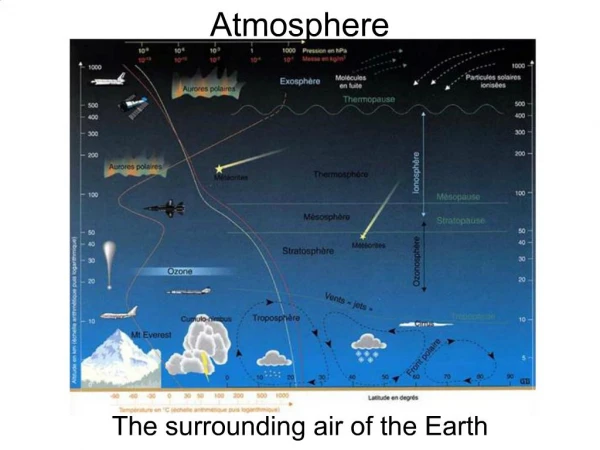
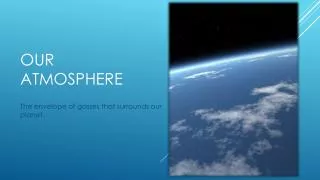
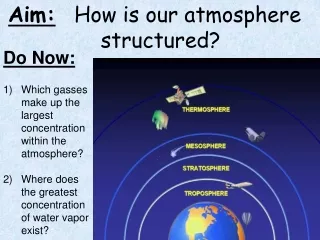
Our atmosphere is a vital thin layer of gases surrounding Earth, essential for life. It provides oxygen, regulates temperature to allow liquid water, and protects us from harmful solar radiation and meteoroids. Composed mainly of nitrogen (78%) and oxygen (21%), it also contains trace gases like carbon dioxide, which is crucial for plant photosynthesis. This greenhouse gas, along with increasing CO2 levels from fossil fuels, is linked to global warming. Ozone, another important component, forms a protective layer against UV radiation. Understanding these elements reveals the atmosphere's role throughout Earth's history and its early formation.

Our Atmosphere
E N D
Presentation Transcript
What is the atmosphere? • The thin layer of gases that surrounds our planet. • Weather is the condition of the atmosphere at a certain place and time. • Our atmosphere makes life possible on our planet. • Provides us with oxygen. • Keeps surface warm so water can exist as a liquid. • Protects the surface from dangerous radiation from the sun. • Protects us from most meteoroids or rocks from space.
The Composition of the Atmosphere • Nitrogen makes up 78% of our atmosphere • Oxygen makes up 21% • Argon makes up almost 1% • All other gases have only trace amounts
Trace elements/compounds • Carbon dioxide: plants use to produce food. Plants take in CO2 and give off oxygen as a waste product. • Animals take in oxygen to make energy and give off CO2 as a waste product. • Fossil fuels (coal, oil, natural gas) give off CO2 when they are burned. Rising CO2 levels may cause global warming. • The fizz in soda is really CO2bubbles. • Dry ice is CO2 in the solid state.
Ozone • Ozone is a molecule of oxygen with 3 oxygen atoms instead of 2. • Often formed when lightning interacts with oxygen in the air. • Forms a layer in the atmosphere that absorbs ultraviolet radiation from the sun. Without this layer life might not be possible on the surface of the planet.
Earth’s Early Atmosphere • The Precambrian atmosphere was composed mainly of nitrogen and carbon dioxide, along with some methane and ammonia. • Volcanoes spewed water vapor, carbon monoxide, and even more nitrogen and carbon dioxide into the air. Comets also contributed water vapor, but no free oxygen. • So where did the abundant oxygen that has made life as we know it come from?
Precambrian Life • The first life on Earth was cyanobacteria (like single celled blue-green algae). • They used photosynthesis to turn CO2 into the food and energy they needed to survive. • Photosynthesis gives off oxygen as a waste product. • So over the millions of years, oxygen given off by algae built up in the atmosphere, while the amount of CO2 declined.