The Complex Dynamics of Mass Migration: Policies, Challenges, and Social Implications
This study explores the multifaceted dimensions of mass migration in the context of historical Jewish immigration to Israel, particularly post-World War II. It examines the demographic shifts and social challenges faced by both Holocaust survivors and new immigrants from Asia and Africa. The analysis delves into the Israeli absorption policies from 1948 to 1952, highlighting the economic hardships and cultural integration strategies, as well as the political ramifications, including ethnic tensions and historical grievances. It also addresses the 'melting pot' concept and its impact on Israeli society.

The Complex Dynamics of Mass Migration: Policies, Challenges, and Social Implications
E N D
Presentation Transcript
Mass Migration Social and Economic Challenge
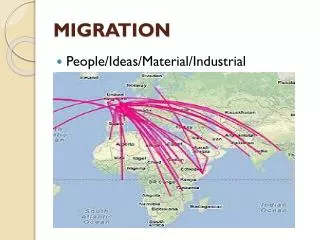
Mass Immigration Policy • Demographic interest • +The long awaited open gates • +The Pro-Israel Jewish consensus • +The active Holocaust Survivors • +The destruction of European Jewry • +The Muslim countries new reservoir • Israeli active Initiative
Absorption Policy - A • Circumstances and Consequences 1948-9: • War Exhaustion during European immigration • Recruiting survivors to the battle front • Abandoned Arab villages and cities • settlement of immigrants in former Arab neighborhoods
Absorption Policy - B • Circumstances and Consequences 1949-1952 • Economic crisis • Immigrants without means • No employment or housing • Temporary sheltering poor conditions • Affecting mainly immigrants from Asia-Africa
Absorption Policy C • “Melting Pot” and survival strategies • == a. To educate-modernize immigrants • == b. Cultural transformation of New Jews • == c. To settle the entire country • == d. Population distribution to peripheries • == e. To focus on the future and forget the past
Social Implications • The gap between old-timers and new immigrants • Ethnic split: • =European (Ashkenazi) better off • =Asian-African (Mizrahi) worse and feeling neglected • Frustration of Holocaust survivors
Political implications UN Resolution 194 December 1948 Clash with the Arab Refugees “Right of Return” Internal implications – ethnic radicalization (The Black Panther” and Wadi Salib Riots) On the longer run: Rebellion against Mapai rule