Une image / un lien ci-dessous est fourni (tel quel) pour télécharger la présentation
Politique de téléchargement : le contenu du site vous est fourni TEL QUEL pour votre information et votre usage personnel ; il ne peut être vendu, concédé sous licence ni partagé sur d’autres sites sans l’accord de son auteur.Le contenu vous est fourni TEL QUEL, pour votre information et votre usage personnel uniquement.Téléchargez la présentation en cliquant sur ce lien.Lors du téléchargement, si vous ne parvenez pas à télécharger une présentation, l’éditeur a peut-être supprimé le fichier de son serveur.Pendant le téléchargement, si vous ne parvenez pas à obtenir une présentation, le fichier a peut-être été supprimé par l’éditeur.
F I N
Plus de contenu associé
Transcription de la présentation
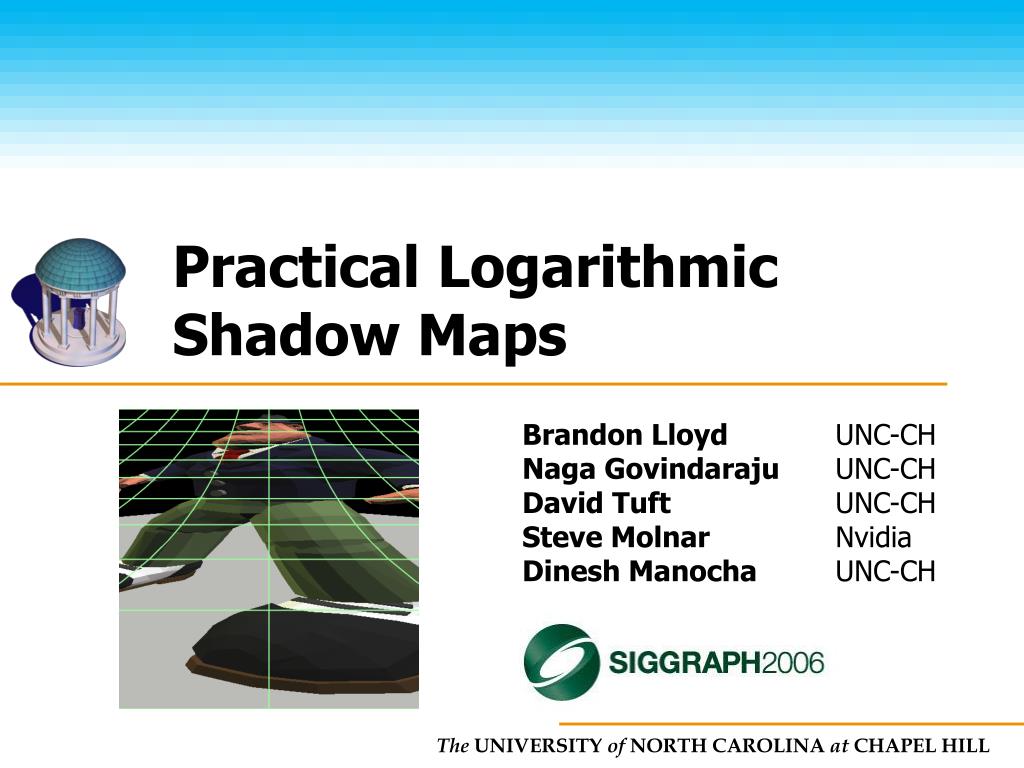
Practical Logarithmic Shadow Maps Brandon Lloyd UNC-CH Naga Govindaraju UNC-CH David Tuft UNC-CH Steve Molnar Nvidia Dinesh Manocha UNC-CH
Motivation • Interactive shadow computation remains a challenge • increasing scene complexity • large, open environments • user expect high quality
Shadow maps • Simple two pass algorithm • Supports wide range of geometric representations • Cheap to render • Disadvantage:Aliasing artifacts at shadow edges
Increase sample density where needed by reparametrizing the shadow map Warping algorithms Light-space perspective shadow maps (LSPSMs) [Wimmer et al. 2004] Perspective shadow maps(PSMs) [Stamminger and Drettakis 2002] Trapezoidal shadow maps(TSMs) [Martin and Tan 2004]
Main results • Logarithmic parameterization for directional and point lights • Error analysis for point lights • Hardware architecture enhancements for logarithmic rasterization
Outline • Related work • Aliasing error • Logarithmic parameterization • Hardware architecture • Results
Separate shadow maps for different parts of the scene Includes cascaded shadow maps Plural sunlight buffers [Tadamura et al. 1999,2001] Partitioning algorithms Adaptive shadow maps [Fernando et al. 2001; Lefohn et al. 2006] Tiled shadow maps [Arvo 2004]
Warping + partitioning • 4x4 matrix • Lixel for every pixel[Chong and Gortler 2004] • PSM with cube maps[Kozlov 2004] • Warping + various frustum partitioning schemes [Lloyd et al. 2006] • Dual paraboloid [Brabec et al. 2002]
Specialized representations Silhouette shadow maps[Sen et al. 2004] Irregular shadow maps[Johnson et al. 2004,2005; Aila and Laine 2004] • Solves the aliasing problem • GPU support requires major changes
Outline • Related work • Aliasing error • Logarithmic parameterization • Hardware architecture • Results
wl wi wi wi wi wl ' ' ' ' ' ' light beam image beam Aliasing error
wl wi wi wl ' ' ' ' cos θi wl m= ≈ wi cos θl θl wl Perspectivealiasing θi wi cos θi Projectionaliasing cos θl Aliasing error light beam wl image beam wi
wi wi wl wl ' ' ' ' cos θi wl m= ≈ wi cos θl θl wl Perspectivealiasing θi wi cos θi Projectionaliasing cos θl Aliasing error light beam wl image beam wi
To eliminate perspective aliasing:wl ≤wi Light beam width depends on: Shadow map resolution Parameterization Controlling aliasing error light beam image beam wl wi
Outline • Related work • Aliasing error • Logarithmic parameterization • Directional light • Point light • Hardware architecture • Results
Vertex program • Transform vertices on the GPU • Requires finely tesselated model • Increases burden on vertex processor • Adaptive tesselation complicated • Easier with DX10 geometry shaders
Brute force rasterization Render bounding primitive Transform fragments to original triangle Discard if not inside 10x slow down Computing bounding primitive is complicated Easier with DX10 geometry shaders Fragment program
Nonlinear rasterization • Configurable rasterizer • Other rasterization functions are possible • Might be useful for other effects • Reflections, refractions, caustics, general multi-view perspective [Hou et al. 06]