
SlideServe
Menu
Préférences
© SlideServe · v2026

Factors that Influence Consumer Behavior

leigh avatar
10 diapositives · 1.2K Views · May 18, 2012

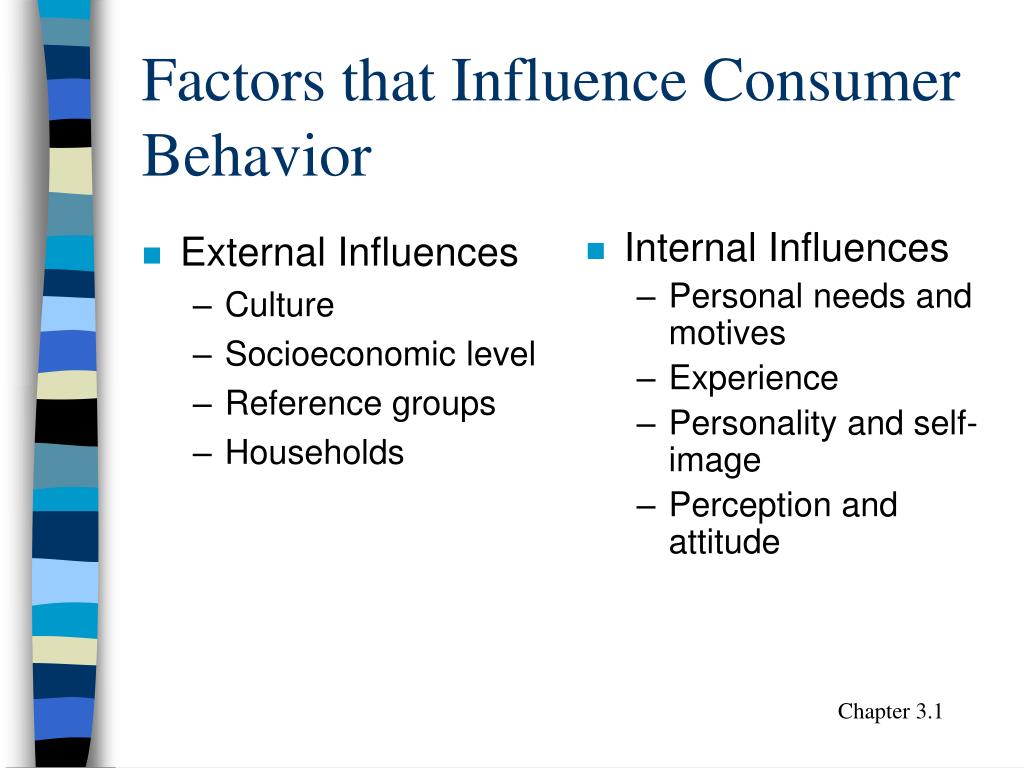
External Influences Culture Socioeconomic level Reference groups Households. Internal Influences Personal needs and motives Experience Personality and self-image Perception and attitude. Factors that Influence Consumer Behavior. Chapter 3.1. Maslow’s Hierarchy of Needs.
Factors that Influence Consumer Behavior - slide 1
01 / 10Factors that Influence Consumer Behavior
1 / 17

Télécharger la présentation

Factors that Influence Consumer Behavior
Une image / un lien ci-dessous est fourni (tel quel) pour télécharger la présentation

Politique de téléchargement : le contenu du site vous est fourni TEL QUEL pour votre information et votre usage personnel ; il ne peut être vendu, concédé sous licence ni partagé sur d’autres sites sans l’accord de son auteur.Le contenu vous est fourni TEL QUEL, pour votre information et votre usage personnel uniquement. Téléchargez la présentation en cliquant sur ce lien. Lors du téléchargement, si vous ne parvenez pas à télécharger une présentation, l’éditeur a peut-être supprimé le fichier de son serveur.Pendant le téléchargement, si vous ne parvenez pas à obtenir une présentation, le fichier a peut-être été supprimé par l’éditeur.

F I N

Plus de contenu associé

Transcription de la présentation
  1. External Influences Culture Socioeconomic level Reference groups Households Internal Influences Personal needs and motives Experience Personality and self-image Perception and attitude Factors that Influence Consumer Behavior Chapter 3.1

  2. Maslow’s Hierarchy of Needs • Physiological Needs • Safety Needs • Social and Belonging Needs • Esteem Needs • Self-actualization Needs Chapter 3.2

  3. Chapter 3.3

  4. Consumer Discretionary Purchasing over a Lifespan • Possession Experiences – less than 40 • Catered Experiences – ages 40 to 60 • Being Experiences – ages 60 to 80+ Chapter 3.4

  5. Consumer Adoption Process • Innovators – 2.5% • Early Adopters – 13.5% • Early Majority – 34.0% • Late Majority – 34.0% • Laggards – 16.0% Chapter 3.5

  6. Consumer Decision-Making Model • Problem recognition • Information search • Evaluation of alternatives • Purchase decision • Post purchase evaluation Chapter 3.6

  7. Compensatory Consumers use a product’s strengths in one or more areas to compensate for deficiencies in other areas Noncompensatory Conjunctive: exceed minimums on all attributes Disjunctive: exceed minimum on at least one attribute Lexicographic: prioritize and consider one attribute at a time Consumer Problem-Solving Processes Chapter 3.7

  8. Consumer Problem-Solving Techniques • Routine Response Behavior – habitual response with little search or evaluation • Limited Problem Solving – some search and evaluation • Extended Problem Solving – extensive search and evaluation Chapter 3.8

  9. Characteristics of Organizational Buying • Larger volume purchases • Derived demand • More emphasis on specifications and service • Professional buyers and more negotiation • Repeat business • Multiple buyers Chapter 3.9

  10. Members of an Organizational Buying Unit • Users – people that actually use the product • Influencers – people with expertise who may help determine specifications • Buyers – people who make purchase • Deciders – people with the authority to select or approve a supplier • Gatekeepers – people who control the flow of information Chapter 3.10