HAX130QU for Quilting
30 likes | 168 Vues
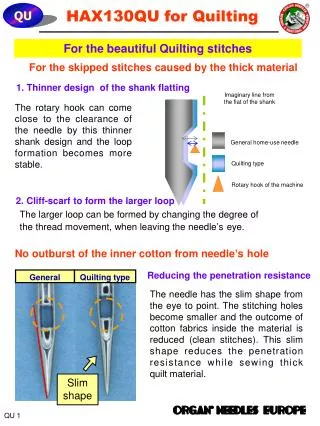
The General Quilting Needle HAX130QU features a slim design ideal for creating beautiful quilting stitches without skipped stitches, even on thick materials. Its thinner shank allows for closer clearance with the rotary hook, enhancing loop formation stability. The clever cliff-scarf design facilitates larger loops, reducing penetration resistance to ensure clean stitches and prevent fraying. Perfect for both home use and experienced quilters, this needle optimizes thread movement and enhances stitching quality for all your quilting projects.


HAX130QU for Quilting
E N D
Presentation Transcript
General home-use needle Quilting type Rotary hook of the machine General Quilting type Slim shape QU HAX130QU for Quilting For the beautiful Quilting stitches For the skipped stitches caused by the thick material 1. Thinner design of the shank flatting Imaginary line from the flat of the shank The rotary hook can come close to the clearance of the needle by this thinner shank design and the loop formation becomes more stable. 2. Cliff-scarf to form the larger loop The larger loop can be formed by changing the degree of the thread movement, when leaving the needle’seye. No outburst of the inner cotton from needle’shole Reducing the penetration resistance The needle has the slim shape from the eye to point. The stitching holes become smaller and the outcome of cotton fabrics inside the material is reduced (clean stitches). This slim shape reduces the penetration resistance while sewing thick quilt material. QU 1
General EB type General Embroidery General Embroidery EB HAX130EB for Embroidery For the beautiful embroidery stitches The special feature of the embroidery is the multidirectional movement of the needle. This makes the thread sometimes become twisted and troubles like skipped stitches and upper thread breakage occur. 1. Larger eye for thicker thread and easy thread movement Larger Loop Cliff-scarf 2. Cliff-scarf to form the larger loop The larger loop can be formed by changing the degree of the thread movement, when leaving the needle’s eye. 3. SES-ball point to protect the thread Thread breakage Protected by the SES-ball EB 1