Download
1 / 5
50 likes | 186 Vues
Waves interact with boundaries in unique ways, leading to phenomena like reflection, refraction, and diffraction. A boundary is defined as a transition point where conditions change, influencing wave behavior. The wave that approaches a boundary is known as the incident wave, while the returning wave is called the reflected wave. Refraction occurs when waves change direction while passing from one medium to another, and diffraction involves a change in direction as waves navigate through openings or around obstacles. Explore these fundamental concepts in wave dynamics.

E N D
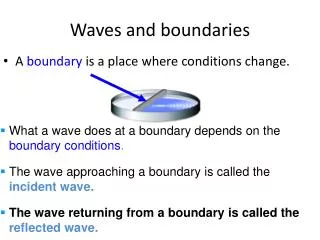
Waves and boundaries • A boundary is a place where conditions change. • What a wave does at a boundary depends on the boundary conditions. • The wave approaching a boundary is called the incident wave. • The wave returning from a boundary is called the reflected wave.
Refraction of waves involves a change in the direction of waves as they pass from one medium to another.
Diffraction - a change in direction of waves as they pass through an opening or around a barrier in their path