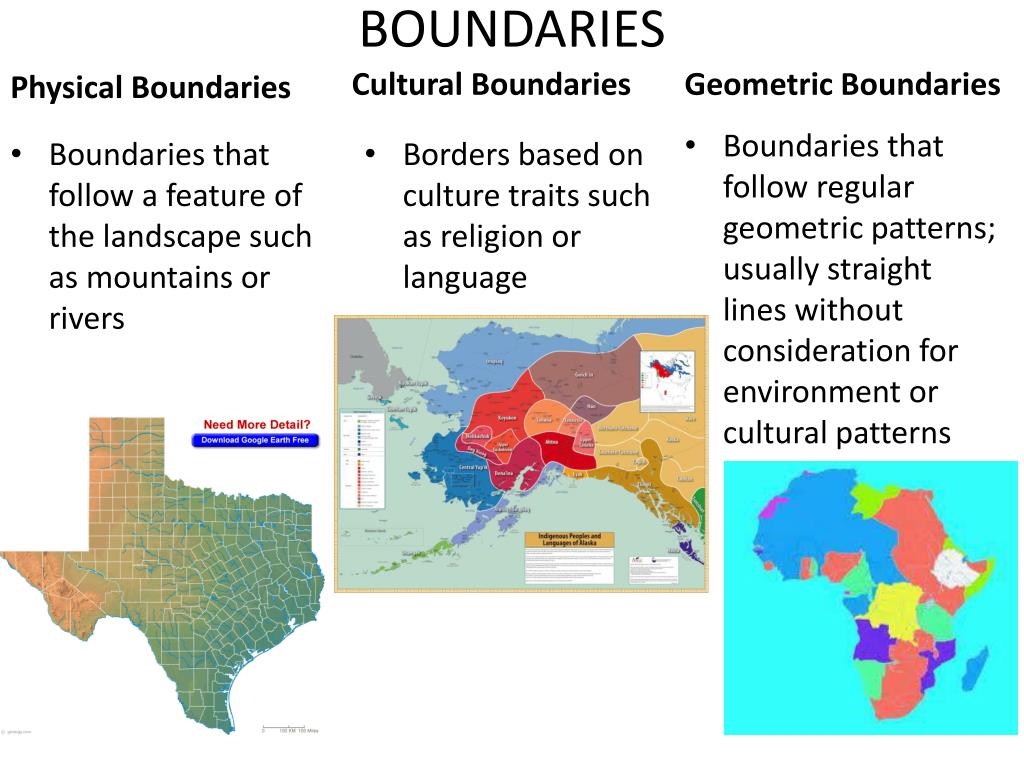
BOUNDARIES Geometric Boundaries • Boundaries that follow regular geometric patterns; usually straight lines without consideration for environment or cultural patterns Physical Boundaries Cultural Boundaries Borders based on culture traits such as religion or language • Boundaries that follow a feature of the landscape such as mountains or rivers
ECONOMIES Traditional/Subsistence Economy • People make goods for themselves and their families; the most basic system; found in poorer, rural areas Market Economy Command Economy The government decides what to produce, where to make it and what price to charge • People freely choose what to buy and sell; competition determines the price of products
Quaternary Economic Activity ECONOMIC ACTIVITIES Tertiary Economic Activity • Process and distribute information; require specialized skills & knowledge • Ex: research scientist, computer programmer, government administrator • Provide services to people and businesses • Ex: doctors, teachers, drycleaners, store clerks, restaurant staff Primary Economic Activity Secondary Economic Activity Use raw materials to produce or manufacture something new Ex: steelmaking, wheat into flour, dairies=milk to cream • Use natural resources directly • Ex: fishing, farming, herding, mining
Sinkhole-a hole in the Earth's surface caused by natural processes of erosion or gradual removal of slightly soluble bedrock (such as limestone) by water
Tree Line-the edge of the habitat at which trees are capable of growing
Tar Sands-sedimentary rocks composed of sand, clay minerals, water and bitumen (oil). Often processed for the oil.
Navigable • deep enough or wide enough to provide passage for vessels such as boats
Taiga • subarctic, evergreen coniferous forest of northern Eurasia located just south of the tundra and dominated by firs and spruces
Cataract • A great downpour; a deluge; such as a large or high waterfall.
Confluence • The connection where two streams begin to flow together
Desertification • The transformation of arable or habitable land to desert, as by a change in climate or destructive land use
Escarpment • a long cliff or steep slope separating two comparatively level or more gently sloping surfaces and resulting from erosion or faulting
Marginal Land • Marginal land is land of poor quality with regard to agricultural use, and unsuitable for housing and other uses
Perennial Irrigation • in which water is controlled so that it can be made to run into the land at regular intervals throughout the year
Veld • An open grassland with few bushes and trees
Monsoon • A wind system in which winds reverse direction and cause seasons of wet and dry weather
Storm Surge • Tropical cyclones’ strong winds cause water to pile up and wash ashore like a high tide
Typhoons • Tropical cyclones that occur in the western Pacific Ocean
Formal Region Has one or more common feature that makes it different from surrounding areas Examples: Sahara Desert, Industrial Park, Dairy Belt, Canada, language, ethnic groups
Functional Region • EXAMPLES: railroad systems, highways, arts districts, shopping malls • Regions that are linked/work together with some form of a center point. If the function of this region ceases to exists, the region no longer exists.
Perceptual (Vernacular) Region • EXAMPLES: “Back Home where I come from…”, “the Midwest”, Dixie, the lower 48… • Reflects human feelings and attitudes. You may not be able to locate them on a map. I’m from “Down Under” mate!
Functional Region
Formal Region Spanish Speaking Countries
Perceptual Region YANKEE!!!
Functional Region
Formal Region CORN BELT
Functional Region DART SYSTEM MAP