Jet Propulsion
Jet Propulsion. Lesson Objectives. After this lesson students should be able to: Define what a jet engine is Describe how Newton’s laws apply to jet or rocket engines List examples of jet engine applications List some key points in the history of jet propulsion

Jet Propulsion
E N D
Presentation Transcript
Lesson Objectives • After this lesson students should be able to: • Define what a jet engine is • Describe how Newton’s laws apply to jet or rocket engines • List examples of jet engine applications • List some key points in the history of jet propulsion • List advantages and disadvantages of jet engines
Definition of a Jet Engine • An engine that burns fuel and uses the expanding exhaust gases to turn a turbine and/or produce thrust • The concept of thrust is based on the principle of Newton’s Third Law
Newton’s Third Law • For every action there is an equal and opposite reaction • An example of this is a spray nozzle on a garden hose
Newton’s Second LawF=M x A • Newton’s second law states - The force of an object is equal to its mass times its acceleration • The force of the spray nozzle is equal to the mass of the water multiplied by the acceleration of the water when it comes through the nozzle • This is the same principle used in rocket and jet engines
Newton in Practice Schematic of a rocket engine Drawing Courtesy of Understanding Flight
Where are jet engines used? Commercial Airliners – Boeing 757
Where are jet engines used? Business and personal jets - Learjet
Where are jet engines used? Military Bombers B-52 “Stratofortress” B-2 “Spirit” Photo Courtesy of www.af.mil
Where are jet engines used? Military Fighters F-15 “EAGLE” F-22 “Raptor” Photo Courtesy of www.af.mil
Where are jet engines used? Helicopters - Apache Photo Courtesy of www.army.mil
Where are jet engines used? M-1 Abrams Tank Photo Courtesy of www.army.mil
Where are jet engines used? Tractor Pulling Photo Courtesy of gasturbine.pwp.blueyonder.co.uk
Where are jet engines used? Speed boats Photo Courtesy of gas-turbines.com
History of Jet Engines • Invented in the 1930’s • Co-invented by Dr. Hans von Ohain (German) and Sir Frank Whittle (British) • Developed their ideas separately and at the time knew nothing of the other’s work
History of Jet Engines • Germans were the first to utilize the jet engine as a military tool • The jet powered ME-262 was the first jet powered airplane to see combat • It had a top speed of 540 mph Photo Courtesy of Stormbirds.com
History of Jet Engines • The SR-71 “Blackbird” set the current speed and altitude record for a jet powered aircraft in 1961 • Its top speed is still classified but is in excess of 2,200 mph Photo Courtesy of NASA
Advantages of Jet Engines • High power to weight ratio • No reciprocating parts • Less parasitic power loss – no need to constantly accelerate and decelerate pistons • Less required maintenance
Disadvantages of Jet Engines • The high speeds and high operating temperatures make designing and manufacturing gas turbines complex from both the engineering and materials standpoint • These complexities lead to a higher price • Jet engines do not produce high torque levels, which is why they aren’t used in automobiles
Review Questions • Describe how a rocket or jet engine produces thrust • How do Newton’s laws relate to jet engine operation • Give some examples of jet engine applications • When and where were jet engines developed • What are some advantages of jet engines • What are some disadvantages of jet engines
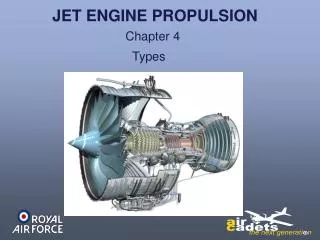
Lesson Objectives • After this lesson students should be able to: • List the six different types of jet engines • Describe how each type of engine propels the vehicle it is used in • List advantages and disadvantages of each type
Six different types of jet engines • Turbojet • Turbofan • Turboshaft • Turboprop • Pulsejet • Ramjet X-15 with ramjet engine Photo Courtesy of NASA
Turbojet Engine • Thrust produced by gasses expelled from the exhaust nozzle • Very noisy • Used on high speed aircraft due to its small size Drawing Courtesy of Understanding Flight
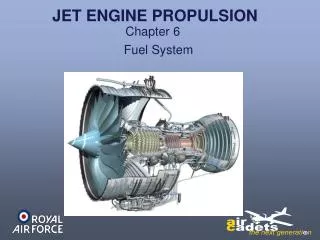
Turbofan • Some of the thrust is produced by gasses expelled from the exhaust nozzle just like a turbojet engine • Most of the thrust is produced from the large inlet fan • The Bypass ratio of a turbofan is typically 8:1 (eight times more air is bypassed than passes through the compressor and combustion chamber) Drawing Courtesy of Understanding Flight
Turbofan Cont’ • If one wanted to increase thrust you would either have to increase the speed of the air being moved or increase the mass of the air being moved (Thrust = Mass x Acceleration) ... However… • It is more efficient to accelerate a larger mass of air to a lower velocity • Due to this principle the turbofan is more efficient than the turbojet • Due to the lower velocity the turbofan is also significantly quieter than a turbojet • Almost all modern commercial aircraft use turbofan engines (excluding the Concord)
Turboshaft • Exhaust gas is used to turn turbine shaft which is then used to propel the vehicle • Exhausted gas produces little thrust because most of the energy is used up by the turbine Drawing Courtesy of www.aircraftenginedesign.com
Turboshaft Cont’ • Because of the high speed (RPM) of a turboshaft engine gear reduction must be used to obtain a usable shaft speed – much like the transmission in your car • This gear reduction also produces torque multiplication Drawing Courtesy of www.aircraftenginedesign.com
Turboprop • A turboprop is essentially a turboshaft engine that is attached to a propeller • A propeller is more efficient at low speeds than a turbofan or turbojet Drawing Courtesy of www.aircraftenginedesign.com
Pulsejet • Doesn’t Use a compressor or turbine • Doesn’t have the ability to produce thrust at low speed (<100 mph) • Germans used this design during WWII in their V-1 “Flying Bomb”
Pulsejet • Uses one-way reed valves in the front of the engine to force exhaust gasses out the rear of the engine and allow fresh air in the front
Ramjet • Used for extremely high speeds (minimum 400 mph) • Doesn’t contain any moving parts (I.e.compressor, turbine, reed valves) • Relies on the inertia of the incoming air for compression • Used in the SR-71 Blackbird at supersonic speeds
Review Questions • What are the six types of jet engines • What is the difference between a turbojet and a turbofan engine? • Which type of jet engine could be used to run a stationary electrical generator? • Why aren’t turbojets used in commercial aircraft anymore? Why not ramjets?
Components of a Turbine Jet Engine Turbine Blade
Objectives • After this lesson students should be able to: • List the basic parts required to construct a jet turbine engine • Describe the difference between an axial flow jet engine and a radial flow jet engine • List the auxiliary systems needed for various jet engines • Explain how an afterburner works
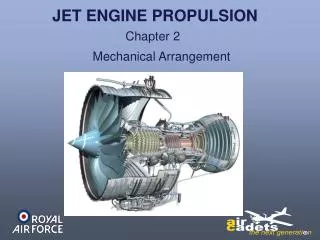
Basic Components of a Turbine Jet Engine • Housing – The rigid frame that supports and contains the parts needed for operation as well as the combustion event • Air inlet and diffuser – The area of the jet where fresh air comes in, the design of the diffuser straightens and alters the speed of the incoming airs
Basic Components of a Turbine Jet Engine • Compressor – Compresses the incoming air at a ratio of approximately 30:1 • Burner or combustion chamber – The area of the engine where fuel is ignited
Basic Components of a Turbine Jet Engine • Exhaust Nozzle – accelerates the engine exhaust to the most efficient and effective speed for producing thrust • Turbine – Converts the energy from the heated and expanding exhaust gasses to a rotating shaft which is used to turn the compressors, or in the case of a turboshaft engine, power the vehicle
Radial vs. Axial Flow • Axial flow compressors – the air travels along the axis of the engine • Radial flow engines use a centrifugal compressor – they push the air out radially rather than along the axis of the engine
Radial vs. Axial Flow • Axial flow compressors are more efficient • Radial flow compressors are less expensive • Most large and high-performance jet engines use an axial flow configuration
Other Essential Systems • Fuel System • Ignition System • Flame Holder • Lubrication System
Other Auxiliary Components • Turbofan – Inlet fan • Turboshaft – Gear reduction unit • Turboprop - Gear reduction unit • Pulsejet – reed valves • Afterburners • Thrust Vectoring Systems
Turbofan Inlet Fan • Most of the thrust is produced from the large inlet fan • The Bypass ratio of a turbofan is typically 8:1
Pulsejet Reed Valves The reed valves force the expanding exhaust gasses out the rear of the engine and allow fresh air to enter the front