Analyzing the Clean Development Mechanism: Trends, Challenges, and Citizen Engagement
This overview presents a comprehensive analysis of the Clean Development Mechanism (CDM) focusing on critical sectors and case studies in India. Experts share insights on non-renewable waste processes, hydro projects, and agricultural impacts. The sessions emphasize the importance of stakeholder consultation, public hearings, and regulations like India’s Right to Information Act. By examining experiences from various host countries, including Uganda and Armenia, the insights aim to inform future engagement and sustainable development practices within the CDM framework.
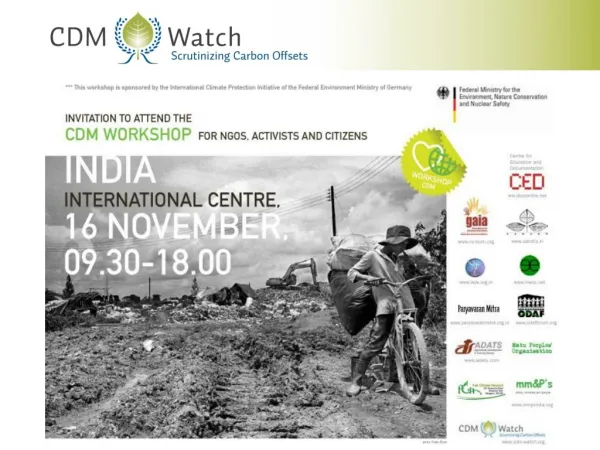

Analyzing the Clean Development Mechanism: Trends, Challenges, and Citizen Engagement
E N D
Presentation Transcript
SESSION I: The Clean Development Mechanism: Overview
CDM overview: trends and analysis Jaisel Vadagam, CSE
Critical perspective of CDM in India Hadida Yasmin, NESPON
SESSION II: Critical CDM sectors & Case studies
Non-renewable CDM options: waste incineration Gopal Krishna, Toxic Watch Poornima Chikarmane, KKPKP
The power of hydro projects, scale of damage Manshi Asher, Environment, Research & Action Collective Vimal Bhai, Matu Peoples’ Organisation
Agriculture and forestry in CDM Sudha Padmanabha, The Fair Climate Network
Mining and HFC projects Dr. Sreedhar Ramamurthi, mines, minerals & People
Key insights from CDM study Ajita Tiwari, Laya
SESSION III: Citizens’ space in the CDM
Stakeholder consultation process, public hearings & India’s Right To Information Act Mahesh Pandya & Hiral Mehta, Paryavaran Mitra
Citizens’ costs: Carbon revenues for end users Ram Esteves, ADATS
The Gold Standard: Evaluation of sustainable development criteria and the role of NGOs Neha Rao, The Gold Standard
Ways to engage in the CDM project cycle & presentation of COP-15 statement Eva Filzmoser, CDM Watch
SESSION IV: Experience from other CDM host countries
CDM in Uganda Chebet Maikut, Ministry for the Environment Uganda
CDM in Armenia Amalia Hambartsumyan, Khazer Ecological and Cultural NGO