Math Sunshine State Standards
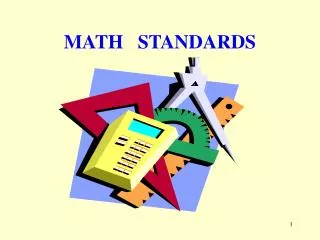
Math Sunshine State Standards. Wall poster. MAA 1.4.1. Associates verbal names, written word names, and standard numerals with integers, rational numbers, irrational numbers, real numbers. MAA 1.4.2.

Math Sunshine State Standards
E N D
Presentation Transcript
Math Sunshine State Standards Wall poster
MAA 1.4.1 • Associates verbal names, written word names, and standard numerals with integers, rational numbers, irrational numbers, real numbers
MAA 1.4.2 • Understands the relative size of integers, rational numbers, irrational numbers, and real numbers
MAA 1.4.3 • Understands concrete and symbolic representations of real and complex numbers in real-world situations
MAA 1.4.4 • understands that number can be represented in a variety of forms, including integers, fractions, decimals, percents and scientific notation, exponents, radicals, absolute value, and logarithms.
MAA 2.4.1 • Understands and uses the basic concepts of limits and infinity
MAA 2.4.2 • understands & uses the real number system
MAA 3.4.1 • Understands and explains the effects of addition, subtraction, multiplication, and division on real numbers, including square roots, exponents, and appropriate inverse relationships
MAA 3.4.2 • Selects and justifies alternative strategies, such as using properties of numbers, including inverse, identity, distributive, associative, transitive, that allow operational shortcuts for computational procedures in real-world or mathematical problems.
MAA 3.4.3 • Adds, subtracts, multiplies, and divides real numbers, including square roots and exponents, using appropriate methods of computing, such as mental mathematics, paper and pencil, and calculator
MAA 4.4.1 • Uses estimation strategies in complex situations to predict results to check the reasonablenss of results
MAB 1.4.1 • Uses concrete and graphic models to derive formula for finding perimeter, area, surface area, circumference, and volume of two-and three-dimensional shapes, including rectangular solids, cylinders.
MAB 1.4.2 • Uses concrete and graphic models to derive formulas for find rate, distance, time, angle measures, and arc lengths
M A B 143 • relates the concepts of Measurement to similarity and proportionality in real-world Situations.
M.A.B. 2.4.1 • selects and uses direct (measured) • Or indirect (not measured ) methods of • Measurement as appropriate.
M.A.B. 2.4.2 • solves real-world problems involving • Rated measures (miles per hour, feet per second).
MAB 341 • solves real-world and mathematical • Problems involving estimates of measurements, • Including length, time, weight/mass, temperature, • Money, perimeter, area, and volume, and estimates • The effects of measurement errors on calculations
MAB 441 • determines the level of accuracy and • Precision, including absolute and relative errors • Or tolerance, required in real-world measurement • Situations.
M.A.B. 4.4.2 • selects and uses appropriate • Instruments, technology, and techniques to • Measure quantities in order to achieve specified • Degrees of accuracy in a problem situation.
M.A.C. 141 • uses properties and relationships of • Geometric shapes to construct formal and informal • Proofs
M.A.C. 241 • understands geometric • concepts such As perpendicularity, • parallelism, tangency, • Congruency, similarity, • Reflections, symmetry, • And transformations • including flips, slides, turns, • Enlargements, rotations, and fractals.
M.A.C. 242 • analyzes and applies geometric • Relationships involving planar cross sections (the • Intersection of a plane and a three-dimensional • figure.)
M.A.C. 341 • represents and applies geometric • Properties and relationships to solve real-world • And mathematical problems including ratio, • Proportion, and properties of right triangle • Trigonometry.
M.A.C. 342 • using a rectangular coordinate system (graph), • applies and algebraically verifies properties • of two-and three-dimensional figures, • including distance, midpoint, slope, parallelism
M.A.D. 141 • describes , analyzes, • and generalizes, Relationships, patterns, • and functions using words • symbols, variables, tables, and graphs
M.A.D. 142 • determines the impact when changing • Parameters of given functions.
M.A.D. 241 • represents real-world problem • Situations using finite graphs, matrices, sequences, • Series and recursive relations.
M.A.D. 242 • uses systems of equations and • inequalities to solve real-world problems • graphically, algebraically, and with matrices
M.A.E. 141 • interprets the data that has been • Collected, organized, and displayed in charts, • Tables, and plots.
M.A.E. 142 • calculators measures of central • Tendency (mean, median, mode) and dispersion • (range, standard deviation, and variance) for • complex sets of data and determines the most • meaningful measure to describe the data
M.A.E. 143 • analyzes real-world data and makes • Predictions for larger populations by applying • Formulas to calculate measures of central • Tendency and dispersion using the sample • Population data, and using appropriate technology • Including calculators and computers
M.A.E. 2.4.1 • determines the probability using theCounting procedures, tables, tree diagrams, and Formulas for permutations and combinations.
M.A.E. 342 • explains the limitations of using • Statistical techniques and data in making • Inferences and valid arguments.