Download
1 / 7
90 likes | 248 Vues
This study analyzes the relationship between ambient air pollution, particularly PM2.5 and black carbon (BC), and heart health indicators during Holter monitoring. Using a dataset of 5,979 valid measurements, the research employs single-pollutant models to estimate the effects of pollution levels on ST-segment depression of at least 0.1 mm. Results are presented through additive mixed logistic regression models, highlighting how increases in pollution correlate with changes in ST-segment levels. This work underscores the importance of environmental factors in cardiovascular health.

E N D
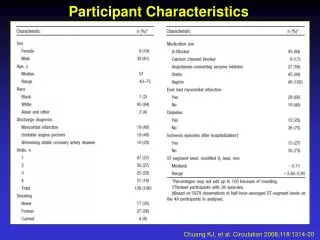
Participant Characteristics Chuang KJ, et al. Circulation 2008;118:1314-20
Ambient Air Pollution and Temperature Levels During Holter Monitoring (5979 Valid Measurements) Chuang KJ, et al. Circulation 2008;118:1314-20
The effects of PM2.5 and BC on half-hour-averaged ST-segment level estimated by single-pollutant models scaled to IQR increase in levels for individual hour mean Chuang KJ, et al. Circulation 2008;118:1314-20
Ambient Pollution as a Predictor of ST-Segment Level Chuang KJ, et al. Circulation 2008;118:1314-20
The effects of PM2.5 and BC on half-hour–averaged ST-segment depression 0.1 mm below a subject-visit set point, as estimated by additive mixed logistic regression models, scaled to IQR increase in levels for individual hour mean Chuang KJ, et al. Circulation 2008;118:1314-20
Effect Modification of Association of ST-Segment Level With Ambient Pollution* Chuang KJ, et al. Circulation 2008;118:1314-20