220 likes | 352 Vues
This document outlines the St. Marys River Control Strategy discussed at the Michigan Sea Grant Regional Fishery Workshop on January 23, 1999. It highlights the use of granular Bayluscide to reduce sea lamprey larvae populations through targeted applications over 800 hectares, and the effectiveness of sterile male release techniques. The results indicated a significant decline in larval abundance while maintaining minimal non-target mortalities. The collaboration involved multiple agencies, ensuring thorough planning and execution for the fishery's health and sustainability.
E N D
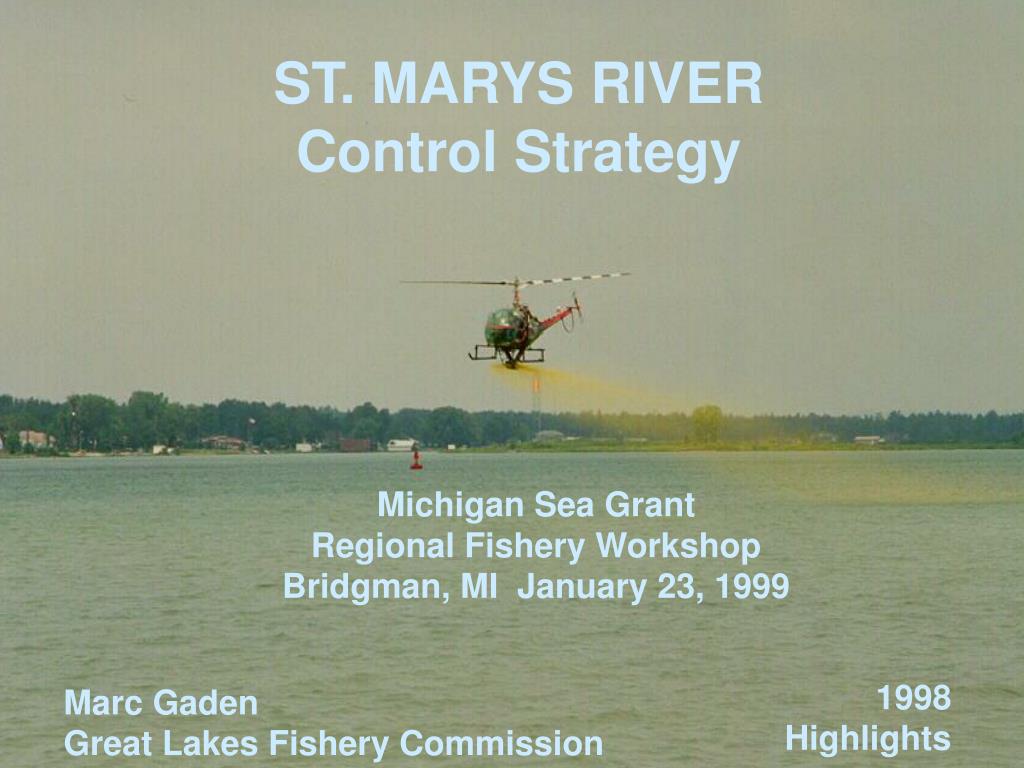
ST. MARYS RIVER Control Strategy 1998 Highlights Michigan Sea Grant Regional Fishery Workshop Bridgman, MI January 23, 1999 Marc Gaden Great Lakes Fishery Commission
ST. MARYS RIVER Control Strategy 1998 Highlights Michigan Sea Grant Regional Fishery Workshop Bridgman, MI January 23, 1999 Gavin Christie Great Lakes Fishery Commission
St. Marys River - Strategy • Remove existing larvae • Reduce reproduction and recruitment
St. Marys River - Strategy • Remove existing larvae • Apply granular Bayluscide • ~ 80 hectares in 1998 • ~ 800 hectares in 1999 • Reduce reproduction and recruitment
Preliminary Planning • Joint DFO/USFWS operation • MDEQ Permit • Staging area • Applicator contract • $ based upon size and distance • Bayluscide delivery
Days before application • News release • Reviewed safety concerns • Developed Standard Operating Procedure • Trained staff in GPS navigation • Assigned duties to staff • Rehearsed operation • Rehearsed again
Day of Application • Set plot corners by GPS for reference • Assigned patrol boats to plots • Security • observe non-target effects • surface collections • underwater video • catch a few sea lampreys • document the operation
81 ha treated July 13 • 12-persons loading • 6 USFWS • 6 DFO • About 6 hours flying Collections: DFO, USFWS, COTFMA, USGS/BRD Media: MDNR, NCTC, Freelance
Let’s see how it looked on the river Video provided under contract by National Conservation Training Center
St. Marys River 3 Treatment Plots
Nontarget effects • Nontarget mortality minimal • Limited primarily to sculpins • Met Michigan DEQ permit requirements • Avoided tern & osprey nest sites
Predicted Effectiveness Preliminary trials suggested 70% effectiveness should be expected
St. Marys River 9 Index Sites Sampled before and after treatment 3 treatment 6 control
Results 76% decline in larval abundance Consistent with earlier field trials
Sterile Male Technique 16,743 released
Reduction in Reproduction • Sterile Male Release and Traps • 62 % average during 1992-1997 • 80 % in 1998
St. Marys River1999 Plans • Apply Bayluscide to about 800 hectares • 280 ha. Canada • 520 ha. U.S. • Trap enhancements • Release 23,000 sterile males • Evaluate success
Summary • Efficient • Effective • Exciting