Understanding Time: Definitions, Types, and Measurements in Astronomy and Atomic Physics
This overview explores various definitions and types of time, emphasizing its significance in periodic phenomena. It discusses stellar and universal rotations, including the sidereal time, which is defined by the hour angle of the vernal equinox. The article also covers orbital motion concerning the Moon and planets, as well as nuclear radiation frequencies used in atomic time measurement. Key time types like UTC, TAI, and variations such as UT1 and GMST are outlined, highlighting their relevance in metrology and everyday applications.

Understanding Time: Definitions, Types, and Measurements in Astronomy and Atomic Physics
E N D
Presentation Transcript
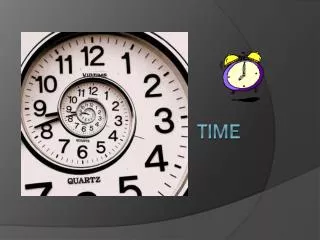
Time=number of repetitions of a periodic phenomenon. Different types: Rotation of the Earth: sideral and universal Orbital motion of Moon and planets: ephemeris, dynamical Frequency of nuclear radiation: atomic time Time USPAS, Cornell University Large Scale Metrology of Accelerators June 27 - July 1, 2005
Sideral time = hour angle of the vernal equinox Types Apparent: using the true vernal point: LAST=Local Apparent Sideral Time GAST=Greenwich Apparent Sideral Time Mean: using the mean vernal point: LMST and GMST Sideral Time USPAS, Cornell University Large Scale Metrology of Accelerators June 27 - July 1, 2005
Universal time = hour angle of the mean Sun + 12 hours Mean Sun = fictitious Sun that moves in the plane of the equator with constant velocity Types: UT0 wrt true pole position UT1 contains the variations in the rotation of the Earth Universal Time USPAS, Cornell University Large Scale Metrology of Accelerators June 27 - July 1, 2005
1 second = duration of 9162631770 periods of the radiation corresponding to the transition between 2 hyperfine levels of the ground state of the Cesium 133 atom. TAI maintained by BIPM (~250 clocks) For daily use: UTC (Universal Time Coordinate) introduced in 1972: UTC=TAI-n (n is integer of seconds) aka GMT or Zulu Time Atomic Time USPAS, Cornell University Large Scale Metrology of Accelerators June 27 - July 1, 2005