DNA Structure
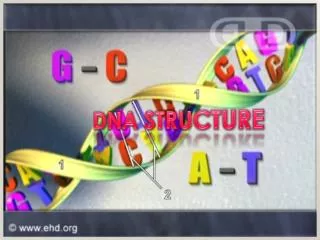
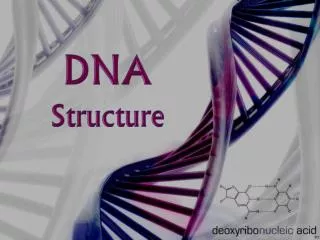
DNA is a complex molecule structured as a double helix, consisting of two intertwined strands. Each strand is composed of nucleotides, which feature a phosphate group, pentose sugar, and a nitrogenous base. The nitrogenous bases—adenine (A), thymine (T), cytosine (C), and guanine (G)—pair specifically, forming the rungs of the ladder-like structure. During DNA replication, the enzyme helicase unwinds the DNA, while DNA polymerase helps synthesize new strands using the original as a template, resulting in two identical DNA molecules.

DNA Structure
E N D
Presentation Transcript
DNA Structure
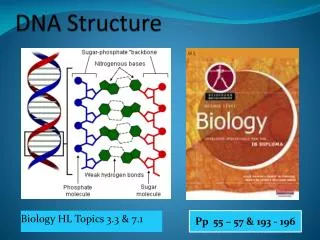
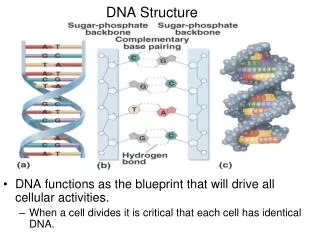
DNA Structure • DNA consists of two molecules that are arranged into a ladder-like structure called a Double Helix. • A molecule of DNA is made up of millions of tiny subunits called Nucleotides. • Each nucleotide consists of: • Phosphate group • Pentose sugar • Nitrogenous base
Nucleotides Phosphate Nitrogenous Base Pentose Sugar
Nucleotides • The phosphate and sugar form the backbone of the DNA molecule, whereas the bases form the “rungs”. • There are four types of nitrogenous bases.
Nucleotides A T C Adenine Thymine G Guanine Cytosine
Nucleotides • Each base will only bond with one other specific base. • Adenine (A) • Thymine (T) • Cytosine (C) • Guanine (G) Form a base pair. Form a base pair.
DNA Structure • Because of this complementary base pairing, the order of the bases in one strand determines the order of the bases in the other strand.
A A A A T T T T C C C G G G
DNA Structure • To crack the genetic code found in DNA we need to look at the sequence of bases. • The bases are arranged in triplets called codons. A G G - C T C - A A G - T C C - T A G T C C - G A G - T T C - A G G - A T C
DNA Structure • A gene is a section of DNA that codes for a protein. • Each unique gene has a unique sequence of bases. • This unique sequence of bases will code for the production of a unique protein. • It is these proteins and combination of proteins that give us a unique phenotype.
DNA Replication • DNA replication is the process of copying a double-stranded DNA molecule. • Produces two copies of DNA that each contain one of the parent strands and one entirely new strand.
DNA Replication • An enzyme called Helicase “unzips” the base pairs by breaking the bonds.
A A A A T T T T C C C G G G Helicase
DNA Replication • An enzyme called Helicase “unzips” the base pairs by breaking the bonds. • Raw materials are needed to “re-build” the two parent strands.
A A A A T T T T C C C G G G
DNA Replication • An enzyme called Helicase “unzips” the base pairs by breaking the bonds. • Raw materials are needed to “re-build” the two parent strands. • Another enzyme called DNA Polymerase is used to arrange nucleotides in a new complimentary strand.
A A A A A A T T T T T T C C C C G G G G G DNA Polymerase
DNA Replication • The result is two identical copies of DNA, each with an original parent strand and a new strand.
A A A A T T T T C C C G G G
A A A A A A A A T T T T T T T T C C C C C C G G G G G G