Download
1 / 22
220 likes | 338 Vues
This presentation discusses the NSPCC and Department of Education's "Keeping Safe" initiative aimed at developing preventative education in primary schools across Northern Ireland. Highlighting outcomes from an RCT study, we explore children's perspectives on safety, capturing insights through photography projects and questionnaires. The study reveals key themes regarding physical safety, feelings of security, and the understanding of abuse. We also address knowledge gaps and the essential role of teachers in implementing effective educational strategies while fostering a whole school approach to child protection.

E N D
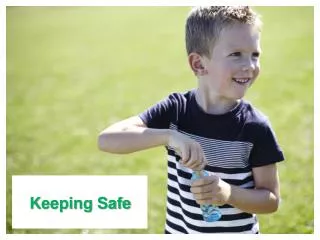
Main title slide Keeping Safe
NSPCC and Department of Education Developing Preventative ‘Keeping Safe’ Education in Primary Schools in Northern Ireland: an RCT Study ICL Conference, Belfast 20-22 February 2014 Dr Aisling McElearney & Phyllis Stephenson
Aims of today • To describe the research process & outcomes whereby children in primary schools were engaged in developing the preventative ‘keeping safe’ education RCT study • Photography project • Children’s Knowledge of Abuse Questionnaire project • 2. To outline RCT study informed by • this research
Findings • New NI evidence - children’s perspective & understanding of keeping safe; 1775 photos grouped into 77 discrete categories and 4 key-themes • Key themes; physical safety & preventing accidents (787 photos, 37.8%), places (796 photos, 38.3%), feeling secure (495 photos, 23.8%), people (482 photos, 23.1%) • Key findings • For majority of children physical safety and accident prevention is core to their understanding of keeping safe • Keeping safe from bullying, child abuse and domestic abuse comprises a small element of most children’s understanding of keeping safe. Includes bullying, stranger danger, good and bad people • Some children are tuned into feeling safe and a small minority indicate they have a role to play in keeping themselves safe
Methodology • Objective – to assess children’s knowledge and understanding of bullying, domestic abuse, appropriate & inappropriate touch, and self-perceived efficacy to keep themselves safe Composite instrument following review & critique of available instruments; - Children’s Knowledge of Abuse Questionnaire (Tutty, 2000) - Efficacy Expectations Subscale (Dake et al, 2003) - Knowledge & Attitudes to Abuse Subscale of Child/Teen Witness to Woman Abuse Questionnaire (Sudermann, 2000) Amended following consultation workshop with children (n=19); order of abuse issues, presentation & fonts, explanations provided to children, child friendly definitions of key concepts • Sample; n=532 P5-P7 children across 16 schools; supported by NSPCC practitioner in class test conditions
Significant results AGE - younger Self-reported SEN Exposure to fewer sources of this information Poor knowledge & understanding; • Role of child in domestic abuse; cause, what to do • Relational bullying • Who presents a risk re sexual abuse, stranger danger mis-message Low self-efficacy to keep safe in abuse situations; telling trusted adult about domestic abuse or inappropriate sexual touching & low self efficacy to keep safe;
Robust evidence of gaps in children’s knowledge, understanding & self-efficacy to keep safe in situations of abuse
NSPCC and Department of Education RCT Study 2013-18
Focus on teachers Children tell teachers & teachers know their children; unique relationship, significant adult for many children Significant opportunities; formal & informal curriculum, accessible population Teachers critical to achieving effective implementation Teachers have asked for training, development & ongoing support to teach sensitive messages
A whole school approach • Embedding Keeping Safe in every school’s vision • Whole school development plan • Monitoring and evaluating • Developing community links School Leadership
A whole school approach • Embedding Keeping Safe in every school’s vision • Whole school development plan • Monitoring and evaluating • Developing community links School Leadership • CPSSS support, training and advice • Support for ongoing CPD • Engaging parents and external partners • Promoting the school vision Designated teacher for child protection
A whole school approach • Embedding Keeping Safe in every school’s vision • Whole school development plan • Monitoring and evaluating • Developing community links School Leadership • CPSSS support, training and advice • Support for ongoing CPD • Engaging parents and external partners • Promoting the school vision Designated teacher for child protection • Teaching sensitive messages • Formal and informal curriculum • Engaging parents and external partners • Creating a culture of listening & telling Classroom teacher
Thank you for your attention amcelearney@nspcc.org.uk phyllisstephenson@nspcc.org.uk Education Advisors Thank you for your attention