Download
1 / 30
300 likes | 470 Vues
Chapter 7 focuses on the axial skeleton, comprising 80 bones that form the body's central axis. It includes detailed information on the skull (28 bones), vertebral column (26 bones), and bony thorax (25 bones). The skull is divided into cranial and facial bones, with the cranium protecting the brain and the facial bones providing structure and support for the face. Key features such as sutures, foramen, orbits, and sinuses are explored, along with a comparison between adult and fetal skull structures. This chapter aims to enhance understanding of human anatomy and bone function.

E N D
CHAPTER 7“The Axial Skeleton”Review your A&P revealed discsCourse objectives:Define and identify the bones of the axial skeleton
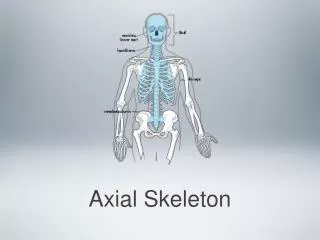
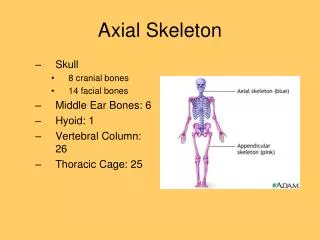
Axial Skelton • 80 total bones • consists of the bones that form the long axis of the body including the: • Skull (total 28 with ear bones) • Vertebral column [(total 26) C7;T12; L5; S1; Co1] • Bony thorax [ribs and sternum (total 25)] • Hyoid bone (1)
Skull BonesReview A&P revealed discsanimation of skull • the skull has two major divisions: Cranium and Facial bones Cranium – the 8 bones that enclose the brain. -1 occipital, 1 frontal, 2 parietal, 2 temporal, 1 sphenoid and 1 ethmoid. • These typical flat bones of the cranium are connected by a special kind of joint called a suture (Synarthroses).
Cranium • Made up of 2 major divisions: • Calvarium (skull cap) • Base • Base contains three large depressions (fossa): • Anterior cranial fossa where the frontal lobes sit • Middle cranial fossa where the temporal lobes sit • Posterior cranial fossa where the cerebellum sits
Sutures/Sutural Bones • Sutures (synarthroses) are immovable fibrous joints. -all bones in the skull, except for the jaw, are united by sutures. The major sutures are: -Coronal -Sagittal -Squamous -Lamboid Sutural bones- small bones that occur within the sutures, especially the lamboid suture. They are not present in all people.
Facial bones • There are 14 bones that can be thought of as creating the face. • As part of this function they provide: - protection for many sense organs, -anchors for many muscles -the openings for air and food to pass. Facial Bones 2-maxillae; 2-palatine; 2-nasal; 2- zygomatic; 2-lacrimal; 2-inf nasal conchae; 1- vomer; and 1-mandible
Sphenoid bone Looks like a Bat in flight. Greater and lesser wings; optic foramen; sella turcica, superior orbital fissure. Dorsal view.
Sphenoid bone Dorsal view Anterior view
Ethmoid bone • Anterior to sphenoid bone forms anterior base of skull and nasal cavity. • Cribriform plate. • Crista gali • Perpendicular plate
Foramen/ Orbits • Foramen: Special openings in bones where nerves, blood vessels enter into the bone cavity. - Ex.: Foramen magnum, Supraorbital Infraorbital, Mental, Jugular, Olfactory, Mandibular • Orbits: Cone shaped bony cavities that hold the eyes, fat, occular muscles and tear glands.
Meatus/ Sinuses • Meatus: a canal or opening into bone - Ex.: external auditory, internal acoustic • Sinus: cavities within bones filled with air. -Ex.: frontal, ethmoid, sphenoid and maxillary sinuses
Cranial fossa Fossa are depressions or cavities in the skull.
The Fetal Skull • Sutures are called fontanels in fetus. • Fontanels -Frontal (anterior) -Occipital (posterior) -Sphenoidal (anterior lateral) -Mastoid (posterior lateral)