Comprehensive Overview of Renewable Energy Technologies in Hydropower
240 likes | 354 Vues
Join us for a detailed webinar presented by Robi Robichaud from the National Renewable Energy Laboratory (NREL), focusing on hydropower as a vital renewable energy source. This session explores both commercial and community-scale hydro projects, including definitions of large, small, and micro-hydropower systems. Attendees will learn about innovative technologies, siting considerations, and the current landscape of hydroelectric power in the U.S. Discover how hydropower contributes to sustainable energy solutions today.


Comprehensive Overview of Renewable Energy Technologies in Hydropower
E N D
Presentation Transcript
Foundational Courses Renewable Energy TechnologiesHydro Presented by the National Renewable Energy Laboratory Webinar – January 29, 2014
NREL’s Presenter on Hydro Energy is Robi Robichaud Senior Engineer Wind & Water Program NREL robi.robichaud@nrel.gov Tel: 303-384-6969
Commercial or Community Scale? Resource Options • COMMERCIAL SCALE PROJECT Influences Technology Choice • COMMUNITY SCALE PROJECT
Scale of Hydroelectric Power Plants Macro Hydropower • Although definitions vary, DOE defines large hydropower as facilities that have a capacity of more than 30 megawatts (MW). Small Hydropower • Although definitions vary, DOE defines small hydropower as facilities that have a capacity of 100 kilowatts (kW) to 30 MW. Micro Hydropower • A micro hydropower plant has a capacity of up to 100 kW. A small or micro-hydroelectric power system can produce enough electricity for a home, farm, ranch, or village. Source: http://www1.eere.energy.gov/water/hydro_plant_types.html
Types of Hydroelectric Power • Waterwheels, used for hundreds of years to mechanically power mills and machinery. • Hydroelectricity, usually referring to hydroelectric dams or run-of-the-river setups. • Damless hydro, which captures the kinetic energy in rivers, streams, and oceans. • Tidal power, which captures energy from the tides in horizontal direction. • Marine Hydrokinetics, which captures mechanical power from the waves,tides or ocean currentsand uses it to directly or indirectly power a turbine and a generator. Grant County Public Utility District successfully demonstrated a fish-friendly Kaplan turbine runner at Wanapum Dam on the Columbia River in Washington Source: http://www1.eere.energy.gov/water/pdfs/48642.pdf
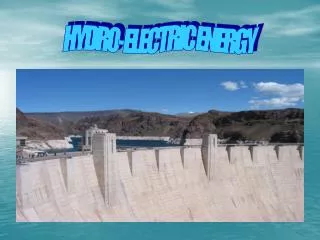
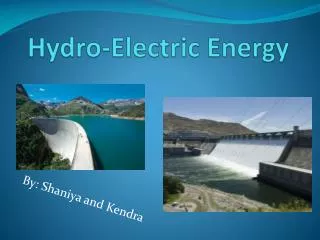
Traditional Hydroelectric and Siting issues – Impoundment • The most common type ofhydroelectric power plant • Typically a large hydropower system • Uses a dam to store river water in areservoir (impoundment) • Water released from the reservoir flows through a turbine, spinning it, which in turn activates a generator toproduce electricity • Water may be released either to meet changing electricity needs;tomaintain a constant reservoir level; of for other downstream users • Significant impacts on fish, land area; potential hazard of dam breaks • Constraints on siting in seismic areas • No significant installations in U.S. in past 50 years, other countries such as China and Argentina moving forward with large installations Graphics Source: http://www1.eere.energy.gov/water/hydro_plant_types.html
Technology Overview – Power Equation Head Power (kW) = 10 x Flow (m3/s) x Head (m) x (metric units) Power (kW) = Head (ft) x Flow (ft3/s or cfs) x /11.8 (imperial units) = turbine-generator efficiency ~80%
Technology Overview and Siting – Diversion Hydro Intake • A diversion, sometimes called run-of-river, facility channels a portion of a river through a canal or penstock • It may not require the use of a dam Outlet • Typically no storage opportunities as with impoundment, lower capital costs due to lack of dam • Fewer concerns with fish and less land area impact than with impoundment Image Sources: Encyclopedia of Alternative Energy
U.S. Electricity Generation 2012 Hydro provides 6-8% of US electricity in most years This is the breakdown of the “Other Renewables” – 5% of US electricity Source: U.S. Energy Information Administration (EIA), May 29, 2012
Costs • High capital costs for hydroelectric projects in general,but typically much higher capacity factors resulting in lower levelized cost of energy (LCOE). Source: http://en.openei.org/apps/TCDB/
Potential Resources • Conventional hydro (low power to large hydro = 62,300 MW): • Capacity gains at large and small hydro = 4,300 MW • New small (<30 MW) and low (<1 MW) hydro = 58,000 MW • New hydro at existing dams = (16,700 MW included above) • [Efficiency gains (4%) = 3,100 MW] • Hydrokinetic = 12,800 MW (tidal only assessed for five states, ocean current not assessed) • Wave Energy = 10,000 to 20,000 MW • Pump storage not assessed • TOTAL = 85,100 to 95,100 MW Virtual Hydropower Prospector Region Selector http://hydropower.inel.gov/prospector/index.shtml
National Hydropower Map Source: http://www1.eere.energy.gov/water/pdfs/national_hydropower_map.pdf
National Hydropower Map – Western U.S. Source: http://www1.eere.energy.gov/water/pdfs/national_hydropower_map.pdf
National Hydropower Map – Western U.S. Source: http://www1.eere.energy.gov/water/pdfs/national_hydropower_map.pdf
National Hydropower Map – Western U.S. Source: http://www1.eere.energy.gov/water/pdfs/national_hydropower_map.pdf
Conventional Hydro Resource Constraints Changing Resource Availability
Wapato Hydropower Project: Successful Example Drop Site 2 Powerhouse Source: Yakama Power
Policy: Federal Energy Regulatory Commission (FERC) The Commission‘s responsibilities include: • Issuance of licenses for the construction of a new project • Issuance of licenses for the continuance of an existing project (relicensing) and new projects • Oversight of all ongoing project operations, including dam safety inspections and environmental monitoring http://ferc.gov/industries/hydropower.asp • Photo: NREL/PIX 13518; Graphic: NREL
Useful Resources • RESOURCE NREL Geographic Information System (GIS) Maps www.nrel.gov/gis/maps.html • TECHNOLOGY Virtual Hydropower Prospector http://hydropower.inel.gov/prospector/index.shtml • POLICY Federal Energy Regulatory Commission (FERC) http://ferc.gov/industries/hydropower.asp
Thank You & Contact Information DOE’S WIND & WATER PROGRAM • http://www1.eere.energy.gov/water/ • http://www1.eere.energy.gov/water/pdfs/48642.pdf DOE’S INDIAN ENERGY PROGRAM • http://apps1.eere.energy.gov/tribalenergy/projects_detail.cfm/project_id=168 • http://apps1.eere.energy.gov/tribalenergy/projects_technology.cfm#Hydropower National Hydrography Dataset – US Geologic Service • http://nhd.usgs.gov/ Oregon State University – PRISM Climate Group • http://www.prism.oregonstate.edu/ Yakama Power • http://www.yakamapower.com/generation.php Robi Robichaud Senior Engineer NREL robi.robichaud@nrel.gov Tel: 303-384-6969