Insights into DNA Supercoiling: Mechanisms, Implications, and Experimental Approaches
DNA supercoiling plays a crucial role in cellular processes, including DNA packaging, transcription, and replication. Most organisms possess negatively supercoiled DNA, regulated by topoisomerases. Traditional methods for studying supercoiling like gel electrophoresis often lack the ability to perform time-resolved studies. Understanding the relationship between torsion, twist, and writhe in DNA topology is essential. This overview discusses experimental techniques to investigate supercoiling dynamics, the effects of ionic conditions, and the thermodynamic properties of twisted and stretched DNA.

Insights into DNA Supercoiling: Mechanisms, Implications, and Experimental Approaches
E N D
Presentation Transcript
DNA Supercoiling in vivo • In most organisms, DNA is negatively supercoiled (s ~ -0.06) • Actively regulated by topoisomerases, ubiquitous and essential family of proteins • Supercoiling is involved in DNA packaging around histones, and the initiation of transcription, replication, repair & recombination • Known to induce structural changes in DNA • Traditional means of study (gel electrophoresis, sedimentation analysis, cryo-EM…) do not provide for time-resolved, reversible studies of DNA supercoiling
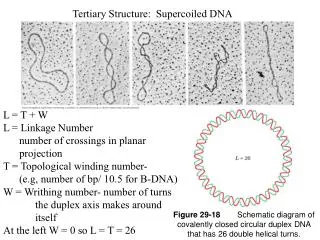
Topological formalism for torsionally constrained DNA Tw (Twist, the number of helical turns of the DNA) + Wr (Writhe, the number of loops along the DNA) _____ Lk (Total number of crossings between the 2 strands) Linking number for torsionally relaxed DNA Lko = Two (Two = 1 per 10.5 bp of B-DNA, Wro= 0) Linking number for torsionally strained DNA DLk = Lk-Lko = DTw + Wr Normalized linking number difference s = DLk /Lko
How to torsionally constrain DNA? DNA must be 1) unnicked and 2) unable to rotate at its ends
Is DNA stretched and supercoiled in vivo or in solution? • Relationship between plasmid and extended DNA. Circular l-DNA with s ~ -0.05 experiences an internal (entropic) tension ~ 0.3 pN
Temperature-dependence of DNA helicity As the temperature increases the DNA helicity progressively increases (i.e. the angle between base pairs increases). Raising the temperature by 15oC causes l-DNA to unwind by ~ 25 turns DNA unwinds by ~ 0.012o/oC/bp
Measuring DNA Unwinding Energeticsusing low-force data +scDNA -scDNA
twist stretch stretch twist A A+ B+ = A B B+ 1 kBT C (2pn)2 lo 2 Paths to Stretched & Overwound DNA TA+ + WA+B+ = WAB + TB+ TA+ + DWAB+ = TB+ =
twist stretch stretch twist A A- B- = A B B- Paths to Stretched, Unwound DNA A- = A+ DWAB- TA- + DWAB- = TB-
kBT C (2pn) G = lo 1 kBT C - Ed= 2p(n-nc)Gc lo 2 Denaturing DNA before the buckling transition (2pnc)2 + Ed TB- =
2p2 kBT C (n-nc)2 lo Measuring the Work Deficit to Stretch Unwound DNA A- = A+ DWAB- Symmetry of plectoneme formation: TA- = TA+ D = DWAB+ - DWAB- = TB+ - TB- =
1/2 (in nm ) Determination of DNA twist persistence length,critical torque for unwinding, and energy of denaturation kBT C - (2pnc) ~ 9 pN nm Gc= lo
High-force properties of supercoiled DNA Negative Supercoiling Positive Supercoiling S-DNA+P-DNA S-DNA Leger et al., PRL (1999) 83: 1066-1069
DNA: the compliant polymorph B-DNA: 10.4 bp/turn 3.3 nm pitch P-DNA: ~2.5 bp/turn 1.5nm/bp S-DNA: 38 bp/turn 22 nm pitch Images: R. Lavery using JUMNA
Effect of torque on transition rates a = aoexp(2pDnnativeG/kBT) b = boexp(-2pDnunwoundG/kBT)