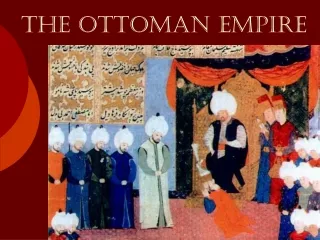
Tolerance and Toleration in the Ottoman Empire: Policy vs. Practice
This examination delves into the concepts of toleration and tolerance within the Ottoman Empire, contrasting theoretical ideals with practical policies. The Ottomans, inheriting a diverse population from earlier Islamic Caliphates, navigated complex religious landscapes while fusing Islamic and Turkic traditions. Key topics include the interaction of Sunni orthodoxy with non-Muslim subjects, the implications of the jizya tax, and the evolving role of non-Muslims over time. Challenges posed by European intervention further complicated Ottoman policies towards religious minorities and led to significant changes during the Tanzimat reforms.

Tolerance and Toleration in the Ottoman Empire: Policy vs. Practice
E N D
Presentation Transcript
The Ottoman Empire Toleration
Tolerance vs. Toleration • Tolerance as an idea, toleration as a policy • Toleration “is better understood as the accommodation of dissent in societies organized around the ideal of religious unity.” (Parker) • Where is the Ottoman Empire on this scale?
Early Period • Ottomans fused Islamic and Turkic traditions into a unique take on Islam. • The Islamic Caliphates had ruled over diverse populations, and the Ottomans inherited these populations. • Christian generals served along the ghazis in the early campaigns.
Muslim Identity • “Public commitment to Sunni orthodoxy…” (Parker) • Jizya tax assessed on non-Muslim subjects. Religious as opposed to temporal tax. • Often paid as a group: ta’ifa and millets • Non-Muslims could not testify against Muslims in courts. • Sartorial laws • Devşirme • Shi’a
Compromise • “… ready pragmatism in dealing with subjugated people” • Letter of the law not always followed: church construction • Evasion
European Intervention • String of reverses reduced Ottoman holdings in Europe • As Muslims constituted a greater share of the population, the Ottomans began embracing the caliphate • At the same time, European strength limited actions against non-Muslim subjects • Apostasy • Protectorates • Tanzimat