Download
1 / 26
260 likes | 379 Vues
This paper explores the potential of small engines, focusing on 4-cycle spark ignition systems, to meet military power needs. It highlights progress in engine weight reduction, performance on jet fuels, and developments in diesel generators. Noteworthy military products, such as a 1.5 hp engine and a Honda gasoline generator, are discussed for their efficiency and practical applications. The paper also speculates on future prospects of smaller, lighter engines capable of high power outputs with good efficiency, essential for enhancing operational capabilities in the field.

E N D
Power for the Soldier: Small Engine Prospects2003 Tri-Service Expo Roger Demler Foster-Miller Inc 781.684.4233 rdemler@foster-miller.com
Perspective on Small Engines(emphasis on 4-cycle spark ignition) • Big picture on power and fuel choices • Real progress • Lower weight in smaller sizes • Good performance on jet fuels • More than competitive • Practical
The last Army owned small gasoline engine. 16 cubic inch single 1.5 hp @3,600 rpm 40 pounds! 1960 US Army 1A08 (runs well on JP-4)
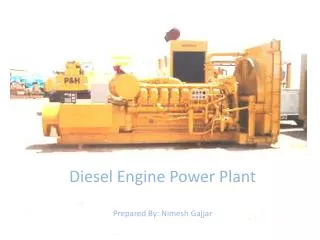
Current Military Diesel Generator Fermont Co. conversion of a Yanmar commercial diesel 3 kW, 123 kg for 25 W/kg
900 W continuous power 58 dB at 7m, 6000rpm 13 kg w/o fuel Engine only efficiency estimated at 30 percent Overall efficiency estimated at 25 percent 1998Product ExampleHonda 1,000 WGasoline Fueled“All Electronic”Control and Power Conversion
Similar Piston Engines4-cycle spark ignition • “Photographic” scale of all dimensions • Proportions remain the same • s = stroke (in.) • b = bore (in.) • = piston speed (fpm) • = “bmep” - break mean effective pressure, (psi) (calculated average pressure on piston during power stroke required to produce measured torque)
Similar Piston Engines(continued) • For now, say bore = stroke (square) Ap = piston area (in2) = 1/4 π b2 ~ s2 • Power limited by airflow (15 x fuel flow), • ideal = 1/4 Ap (four cycle) ~ s2• • Real air flow limited by intake valve pressure losses determined primarily by piston speed • Similar engines have same gas velocities andvolumetric efficiencies at same piston speedleading to same versus
Similar Piston Engines (continued) Using stroke, s as reference dimension Power: hp = (four cycle engine)For given that also fixes Hp ~ Ap ~ s2 (b/s assumed constant) D, displacement ~ s3 hp/D ~ s2/s3 ~ 1/s Rpm at constant ~ 1/s Wall thickness ~ 1/s Thermal resistance ~ 1/s Pressure stress ~ ~ s/s = constant Weight ~ s3 hp/lb ~ s2/s3 ~ 1/s
Similar Piston Engines(continued) • Dynamics • Piston acceleration, a ~ v2/r ~ 2/s~ 1/s • Piston weight, w ~ s3 • Piston inertia ~ aw ~ s3/s ~ s2 • Bearing area ~ s2 • Bearing pressure ~ inertia/area ~ s2/s2 = 1 • Noise • dB = f(10log power) i.e., 1/10 power = -10dB
Small engines can be efficient
Small Engine Test RigFor JP-8 Use in a 0.41 Cubic Inch Displacement Enya 41Four-Stroke-Cycle Spark-Ignition Engine
Palm Power Engine • Objectives • 25W at 48,000 rpm • 1/4 in. bore and stroke • 4-cycle sleeve valve • JP-8 fuel with electric hea • Very conservative loadings • Low piston speed, 1,000 fpm • Low working pressure, 90 psi bmep
Foster-Miller 20W Micro-Generator • 70g dry weight with large intake and exhaust silencers • 25 percent efficiency for 3,000 Whr/kg of JP-8 fuel • 4 cycle piston engine with smart glow plug ignition • 12V brushless alternator/starter and starting battery
Preliminary Design of 100W Generator Engine bore = stroke = 0.5” displacement: 0.1 cu.in. speed: 22,000 rpm piston speed: 1,800 fpm bmep: 90 psi power: 0.24 hp, 175W
Prospectus:Much Smaller Spark Ignition Engines • Relatively lighter • Similar in efficiency • Same stresses, velocities and bearing loads • Easier to cool • Higher cyclic fatigue considerations • Proportionately quieter • More likely to run well on JP-8 or kerosene • Necessary technology already mass produced