Radiation Environment Testing of HOEs by NASA: Optical Performance Evaluation
120 likes | 273 Vues
This report presents a comprehensive study on the effects of varied radiation environments on Holographic Optical Elements (HOEs) conducted by Geary Schwemmer at NASA GSFC. Supported by NASA and IPO, tests evaluated the impact of electron (gamma), proton radiation, and ultraviolet exposure on the optical performance of five HOE samples. The study includes results on diffraction efficiency, transmission at specific wavelengths, and the gamma exposure effect on these parameters. Findings indicate moderate absorption and minimal hologram fading, along with insights for future testing with thinner glass and proton radiation.


Radiation Environment Testing of HOEs by NASA: Optical Performance Evaluation
E N D
Presentation Transcript
Space Radiation Environment Tests on HOEs Geary Schwemmer* NASA GSFC Work Supported by NASA and IPO *new affiliation: Science and Engineering Services, Inc. Columbia, MD
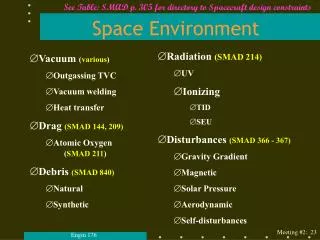
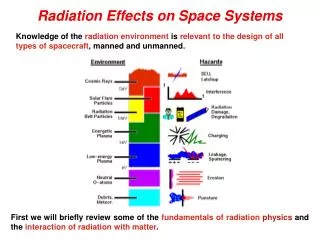
Radiation Environment • Electron (gamma) radiation • Proton radiation • Ultraviolet
Five-HOE ShADOE Samples 5.7 mm PPG Starphire glass 10 µm DCG hologram 10 µm Epoxy 5.7 mm PPG Starphire glass
Optical Tests Before & After Exposure • Diffraction efficiency at 355 nm • 0° incidence transmission at 355 nm and 2-µm wavelengths • 355 nm absorption 30° 30°
Gamma exposure effect on diffraction efficiency, preliminary results
Gamma exposure effect on transmission at 355 nm, preliminary results
Co 60 1.25 MeV gamma ray exposures 0 KRad 3 KRad 30 KRad 300 KRad
254 nm UV exposure @ 100 nW/cm^2 for 12 min = 3.15 J/cm2 equivalent to ~ 1 year in orbit
Conclusions & future tests • Moderate 355 nm absorption due to gamma radiation over NPOESS mission life: ~25% thru 11.4 mm of glass. • Little to no hologram fading due to 254 nm or gamma radiation exposure. • No degradation at 2-microns. • Thinner glass will decrease absorption. • Proton radiation & high intensity 355nm UV tests TBD