The Uniqueness of WWII: A Comprehensive Overview
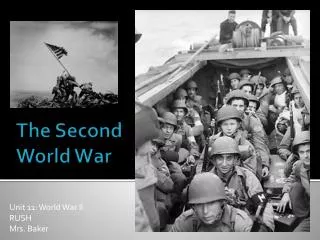
World War II remains the deadliest conflict in history, involving over 100 million military personnel and resulting in 50-70 million fatalities. It was characterized as a "total war," affecting entire nations and their populations. Major events included the Holocaust, the invasion of Poland, Operation Barbarossa, and the significant battles of Stalingrad and Normandy. The war ended with the atomic bombings in Japan and led to major political shifts, including the establishment of the United Nations and the beginnings of the post-war order.

The Uniqueness of WWII: A Comprehensive Overview
E N D
Presentation Transcript
Uniqueness of WWII • 100 million military personnel mobilized • Total war • Deadliest conflict in history • 50-70 million fatalities • Holocaust • 12 million Germans become refugees
1939 • March – Bohemia/Moravia Protectorate • April – Italy invades Albania Britain introduces conscription • May – Pact of Steel with Italy Anglo-German Naval agreement and Polish non-aggression pact denounced • August – Soviet-German nonaggression Pact and secret protocols (Ribbentrop-Molotov) divides Eastern Europe Hitler speaks to generals Poland to be occupied, depopulated and Germanized, Western leaders “poor worms”. 1 September invasion of Poland starts 3 September British-French ultimatum
1940 • March – Soviets invade Finland • April – Germany invades Denmark and Norway • May – Churchill PM, Low Countries invaded • June – 2/3 of France occupied • June – Soviet occupies Baltic states • July – Italy invades parts of France (Nice and Savoy) Germany offers peace to Britain • Summer/Fall – Battle of Britain, Operation Sera Lion aborted • Sept. – Tripartite Pact (Axis Pact) Japan, Germany, Italy • Dec. – Plan Barbarossa
1941 • March – Lend/Lease US assistance to UK/SU (800 bn. in todays USD) • April – Balkans and North Africa • June – German attack on the Soviet Union (two fronts) • Dec. – Pearl Harbor and Japanese invasion of European colonies of South-East Asia
Beginning of the end 1942-43 • Oct. – Al Alamein • Nov- Allies land in Algeria • Dec. – Stalingrad defeat • Spring of 43 – Italian landings • June 43 – De Gaulle
Towards the end Jan. 1944 – Germany forced out of Leningrad June 1944 – Normandy landings • Aug. 1944 – Paris liberated • Feb. – Budapest liberated by Soviets • April 1945 – US and SU troops meet at Elbe • 7 May 1945 – surrender and occupation • War in Asia ends with atomic bombs on Japan July/August 1945
Peace making – New Order • Aug 1941 – Atlantic Charter (Churchill and Roosevelt) (blue print of post-war order) • Jan. 1942 - Declaration of “United Nations” (Allies) • June 1943 – Casablanca (3 leaders commit to unconditional surrender) • Dec. 1943 – Tehran (4 policemen, call for 2nd front, demilitarize Germany, occupation zones, Poland’s borders) • Feb. 1945 Yalta (SC voting, Joint declaration on liberated Europe, Lublin, Balance of Power) • April 1945 – Churchill fails to persuade Roosevelt to liberate Berlin, Prague and Vienna ahead of Soviets • 25 April – UN conference starts in San Fransico • July-August 1945 – Potsdam division of Europe