Download
1 / 9
90 likes | 201 Vues
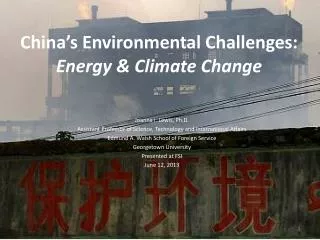
China faces significant environmental challenges due to rapid industrialization and urbanization, resulting in severe pollution affecting air, water, and soil, causing millions of premature deaths annually. This presentation outlines key factors leading to the development of environmental risk, examines the current state of regulations and insurance policies, and identifies troubling gaps in enforcement and coverage. With an aging population and rising public awareness, the Chinese government is compelled to respond with increased regulation and innovative financial mechanisms, yet many challenges remain to be addressed.

E N D
Environmental Challenges in China Pollution and Beyond
Karl J Russek • Senior Vice President, Environmental Risk • ACE Overseas General
Key Objectives • Outline some key factors leading to the rapid development of environmental risk in China. • Discuss the current state of Environmental Regulation and Environmental Insurance in China. • Outline developing trends and troubling gaps in the current regulatory approach to insuring environmental risk in China.
China’s Unprecedented Rise:Not Without Consequences for its People • Largest rapid industrialization in history = Largest human migration in history. Almost 1bn people have migrated from the countryside to urban centers. • Offshoring of vast chunks of US/EU industry was not solely due to lower labor costs. Heavy industry, basic chemicals, etc. = disproportionately polluting industries + coal for power generation • Major air, water and soil pollution issues, soaring cancer rates: Pollution estimated to kill ~1.3M people per year (Source: the Lancet) • Changing Demographics.China’s population is increasingly aging (though still quite young), better paid, better educated, and better connected
Government Forced to Respond Large growth can’t be sacrificed • Energy: Massive investment in nuclear and renewables. Solar and Wind + modernization and efficiency of other sources. Next: unconventional gas? • Increased regulation and stepped-up enforcement of existing rules. Criminal penalties, strict liability, “polluter pays” : all strong on paper. Enforcement in practice? A matter of political will. • Financial Mechanisms: Conditions for financing, securities rules, financial assurance requirements • Compulsory Insurance: Pools established for specific regions
Compulsory Pollution InsuranceManaged on a Provincial Level • Pilot programs in nine provinces & two municipalities • Targets certain industries (those deemed heavy polluters by the government) • Low limits • Coverage limited to sudden & accidental trigger only • Each Insurance Pool consists of several local insurers • No meaningful risk selection • No loss control services provided by the provincial schemes
Remaining Gaps and IssuesSignificant questions remain… • Provinces focused on what was politically possible. • Current legal context imposes Strict Liability and mandates cleanup, however: • The approved scheme coverages are extremely narrow (e.g. Sudden and Accidental). • There is typically no provision for first-party cleanup. • Individual policies must be purchased within each scheme. • Broad 1st and 3rd party “U.S.-Style” pollution cover IS available in China for firms who apply a global EHS standard. • Can this be used to satisfy local requirements? Open question. • The most significant risk CAN still be transferred, however.
Questions? Contact Information: Karl J Russek Senior Vice President, Environmental Risk ACE Overseas General 100 Leadenhall Street, London, EC3A 3BP. T +44 (0) 20 7173 7541 M +44 (0) 77 66 99 44 78 Karl.Russek@acegroup.comwww.acegroup.com