Pangaea and Continental Drift
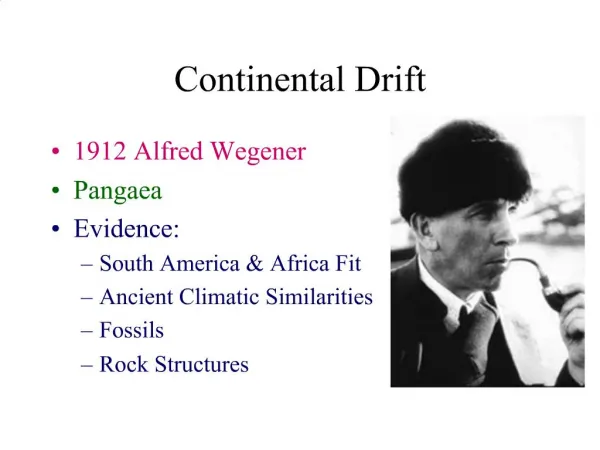
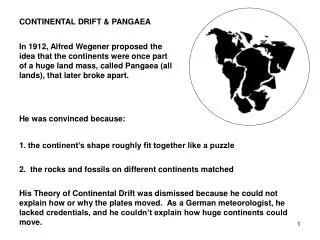
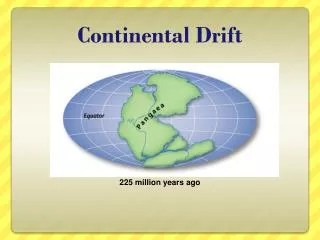
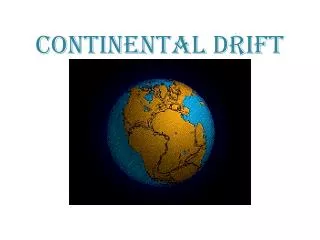
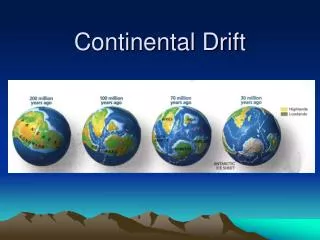
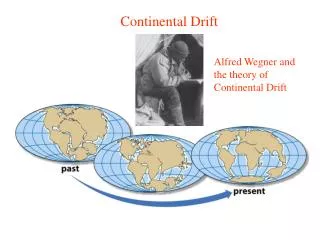
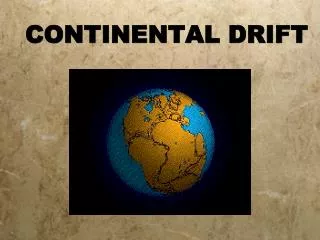
In 1915, Alfred Wegener introduced the revolutionary theory of Continental Drift, suggesting that Earth's crust slowly drifts atop a liquid core. He proposed that all land was once connected as a single supercontinent named Pangaea, meaning "All Land." Wegener highlighted the breakup of Pangaea into two major land masses, Laurasia and Gondwanaland, which further fragmented over time. He presented fossil, climate, plant, and geological evidence supporting this idea. Today, the theory of Plate Tectonics builds on Wegener's foundation, illustrating the ongoing movement of continents.

Pangaea and Continental Drift
E N D
Presentation Transcript
In 1915, Alfred Wegner, came up with the theory of “Continental Drift.” He believed that Earth’s crust drifted slowly on top of a liquid core. • He hypothesized that Earth was one super continent that he called Pangaea. • Pangaea means “All Land”
Wegner also proposed that Pangaea first broke into 2 large land masses, Laurasia and Gondwanaland. • These two continents would continue to be broken apart over time.
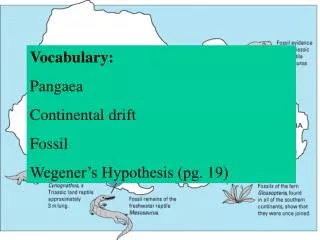
Fossil evidence also supports this theory. Tropical plants have been found in coal deposits in Antarctica.
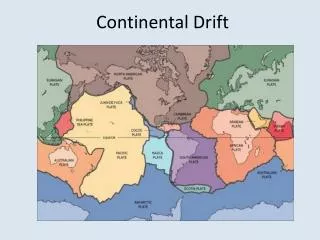
Today’s theory of Plate Tectonics is a more complete picture that includes evidence that the continents have moved and are still moving
Evidence for Continental Drift • Go to p. 277-278 in book. Write the different clues for evidence of Pangaea. • Fossil clues • Widespread plant clues • Climate clues • Rock clues