UNDERSTANDING CIRCUITS
This guide explores the fundamentals of series and parallel circuits, emphasizing their distinct properties and functions. Series circuits provide a single path for electron flow, meaning a break can halt electricity to all components, leading to dimmer lights with more bulbs due to increased resistance. In contrast, parallel circuits consist of separate branches, allowing for continued flow even with failures in some parts and maintaining brightness across multiple bulbs. The guide also introduces schematic diagrams and standard symbols for circuit representation, aiding in the design and analysis of electrical systems.

UNDERSTANDING CIRCUITS
E N D
Presentation Transcript
Series Circuits • Series Circuits – provides only one path for the electrons to follow • 1. A break in the circuit stops the flow of electricity to all other parts of the circuit • 2. With multiple light bulbs (more resistance) the current reduces & the dimmer the lights become • 3. Ammeters should be wired in series
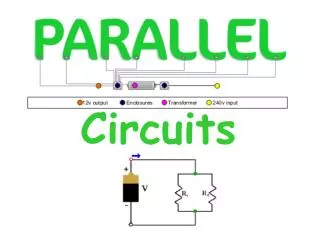
Parallel Circuits • Parallel circuits – the different parts of the circuit are on separate branches • A break (burn out light bulb) in the circuit doesn’t stop the flow to the remaining devices • Multiple light bulbs will remain the same brightness since the resistance is not decreasing as it does in a series circuit. • Each pathway can be separately switched off w/out affecting the others • Household circuits – Wired in parallel, with a standard of 120 volts • Voltmeters are wired in parallel
Parallel Circuits • The more paths the LESS the resistance • Water example again: added pipes coming from a large tank will allow more water to flow out that a single pipe. • Therefore as resistance degreases, current increases; they are inversely proportional
Schematic Diagrams • All circuits need at least the following • Power supply, wire, resistors, other items include switches, connectors, meters, etc. • There is a set of standard symbols used to represent these items in a diagram of the circuit