Understanding Basic Electrical Circuits: Key Symbols and Concepts
This guide covers fundamental concepts in electrical circuits, emphasizing the flow of electricity, voltage, current, and resistance. It explains how electricity travels from the positive (+) to negative (-) terminal of a battery and the relationships between voltage (V), current (I), and resistance (R). Ohm's Law is introduced, illustrating how these quantities interrelate: I = V/R. Important symbols and units are also outlined for better understanding, making this resource valuable for anyone seeking clarity in electrical engineering.

Understanding Basic Electrical Circuits: Key Symbols and Concepts
E N D
Presentation Transcript
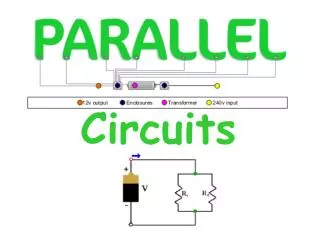
Important Reminders AND Terms • The flow of electricity always travels around the circuit from the (+) end of the battery toward the (-) end. • Voltage: Pushes Electrons, electrical potential • Measured in Volts (V) • Current: Flow of Electrons through a circuit • Measured in Amps (a) • Resistance: Resists Current Flow • Measured in Ohms (Ώ) THESE THREE QUANTITIES ARE LINKED – CHANGE ONE AND ONE OR BOTH OF THE OTHERS WILL CHANGE AS WELL!!
I = V/R Ohm’s Law • Current Symbol: I Unit: amps (A) • Voltage Symbol: V Unit: volts (v) • Resistance Symbol: R Unit: ohms (Ώ)