Download
1 / 12
120 likes | 252 Vues
This document examines the complexities involved in detecting suspicious behavior in outdoor environments through video analysis. It highlights major challenges, including occlusion, camouflage, and environmental factors such as dust, shadows, and illumination changes. Different methodologies are discussed, from motion analysis to background subtraction techniques, outlining their advantages and disadvantages. Key topics include the aperture problem, slow background learning, and issues with false detections caused by glare or environmental disturbances. The need for robust detection approaches in dynamic outdoor settings is underscored.

E N D
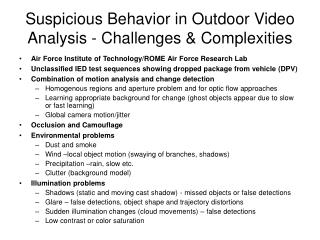
Suspicious Behavior in Outdoor Video Analysis - Challenges & Complexities • Air Force Institute of Technology/ROME Air Force Research Lab • Unclassified IED test sequences showing dropped package from vehicle (DPV) • Combination of motion analysis and change detection • Homogenous regions and aperture problem and for optic flow approaches • Learning appropriate background for change (ghost objects appear due to slow or fast learning) • Global camera motion/jitter • Occlusion and Camouflage • Environmental problems • Dust and smoke • Wind –local object motion (swaying of branches, shadows) • Precipitation –rain, slow etc. • Clutter (background model) • Illumination problems • Shadows (static and moving cast shadow) - missed objects or false detections • Glare – false detections, object shape and trajectory distortions • Sudden illumination changes (cloud movements) – false detections • Low contrast or color saturation
Dropped package from vehicle (DPV) sequences - Logitech Orbit 20ft Vertical Run 2 Frame 150: Event of interest marked
Detecting Occluded EventSequence - Logitech Orbit 20ft Vertical Run 3 Frame 121: Event of interest marked
Glare and ShadowsSequence - Logitech Orbit 10ft Vertical Run 2 Frame 43: False detection due to glare Frame 141: Event of interest marked
Dust and ShadowsSequence - Logitech Orbit 10ft Vertical Run 3 Frame 159: Event of interest marked Frames 72&170: False detection due to dust
Dust and ShadowsSequence - Logitech QuickCamPro 5000 10ft Vertical Run 3 Frame 91: False detections due to dust Frame 150: Event of interest missed due to shadow and insufficient contrast
Sequence - Logitech QuickCamPro 5000 20ft Vertical Run 2 No event of interest
Sequence - Logitech QuickCamPro 5000 20ft Vertical Run 3 Frame 104: Event of interest marked
Effect of Learning Rate in Background Modeling Sequence - Logitech Orbit 10ft Vertical Run 2 Frame 86: Correct Detection when in motion Frame 210: Ghost object left behind (due to slow background learning using Mixture of Gaussians) when the car starts to move again Frame 134: Object that stops for a while blends into the background
Problems with Flow-based ApproachesSequence - Logitech QuickCamPro 5000 20ft Vertical Run 1 Frame 24: Aperture problem, motion of homogeneous regions is not detected Frame 83: Larger temporal window results in false detections and larger object boundaries Frame 35: Non-moving objects not detected
Suspicious Behavior in Outdoor Video Analysis - Challenges & Complexities • Combination of motion analysis and change detection • Homogenous regions and aperture problem and for optic flow approaches • Learning appropriate background for change (ghost objects appear due to slow or fast learning) • Global camera motion/jitter • Occlusion and Camouflage • Environmental problems • Dust and smoke • Wind –local object motion (swaying of branches, shadows) • Precipitation –rain, slow etc. • Clutter (background model) • Illumination problems • Shadows (static and moving cast shadow) - missed objects or false detections • Glare – false detections, object shape and trajectory distortions • Sudden illumination changes (cloud movements) – false detections • Low contrast or color saturation
Moving Object Detection Approaches Optical Flow Analysis: Characteristics of flow (velocity) vectors of moving objects over time are used to detect changed regions. Advantage: can be used in the presence of camera motion. Disadvantage: usually computationally expensive & aperture problem. Change Detection Background subtraction: Moving regions are detected through difference between the current frame and a reference background image. | framei-Backgroundi |>Th Advantage: provides the most complete feature data. Disadvantage: sensitive to dynamic scene changes due to lighting and extraneous events and cannot handle global motion. Temporal differencing: Similar to background subtraction but the estimated background is the previous frame. | framei-framei-1 |>Th Advantage: very adaptive to dynamic environments. Disadvantage: has problems in extraction of all relevant feature pixels (aperture problem).