Progress in Culturing Marine Microbes: Updates on Strains and Research Efforts
This document outlines the current status of marine microbe cultures, focusing on both completed and in-progress strains. Important updates include the organization of stable cultures for transfer to the RCC, progress on selected strains, and completion status of significant research papers. It addresses critical missing data, the identification of new strains requiring focus, and insights from various studies on Prasinophyceae, Dinophyceae, and more. Prominent topics include pigment analysis, DNA sequencing, and advancements in probe methods for environmental samples.

Progress in Culturing Marine Microbes: Updates on Strains and Research Efforts
E N D
Presentation Transcript
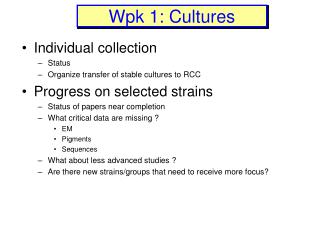
Wpk 1: Cultures • Individual collection • Status • Organize transfer of stable cultures to RCC • Progress on selected strains • Status of papers near completion • What critical data are missing ? • EM • Pigments • Sequences • What about less advanced studies ? • Are there new strains/groups that need to receive more focus?
Wpk 1: CulturesNear completion • Prasinophyceae • Paper Laure: • species included ? • what is missing ? • Paper on PFGE by Banyuls team • RCC 391 (Mamiella) • Specific paper by Wenche/Jahn ? • Dictyochophyceae • Paper Wenche on RCC 446 (Dictyocha like) • Closely related strain in Blanes collection • Study of Rhizochromulina like (RCC 332 + others) ? • Telonema
Wpk 1: CulturesIn Progress Wpk 1: CulturesIn progress • Prymnesiophyceae • Chrysochromulina strains • Data to be acquired (sequences, pigments) • Other strains from Blanes • Chrorarachniophyceae • RCC 365 • Data to be acquired (sequences, pigments) • What about the larger Chlorara RCC 337 • Other groups • Dinophyceae: Exuviella like (RCC 303) • Eustigmatophyceae: Nannochloropsis (RCC 357 + Blanes strains) • Trebouxiophyceae: Nannochloris like • Chlorophyceae: Chlamydomonas like (two strains)
Wpk 2: Clones libraries • 18S library analysis of coastal sites • 16S library analysis of coastal sites • Full sequences • Telonema --> Kamran • Red group --> Klaus • Prasinophyceae --> Laure • Stramenopiles --> Ramon (Blanes) • Alveolates --> Agnès (Roscoff) • Cercozoa --> David Moreira ??? • Other ???
Wpk 4: Probe methods • DNA chips • FISH-TSA with flow cytometry • Problems with non-Chlorophyta • Applicability ? (couple with sorting followed by cloning) • Quantitative PCR • Test a bit further Taqman vs SYBR • Primer optimization: • amplification efficiency • specificity • Groups targeted • General eukaryotic primers • Prasinophyceae • Normalization: use cloned DNA • Do some more tests: • Mixed populations • Natural samples • Apply on large scale
Wpk 3: Probes Validated and used on field samples • Synechococcus (UW): paper in preparation • Stramenopiles (ICM): paper submitted • Prasinophyceae (SBR): paper in preparation • Cryptophyceae Crypt13 (SBR): validated (included in time series paper ?) In progress • Hetero01 (AWI): signal and specificity problems • Env Rhodophyta-like (SBR): almost validated • Prymnesiophytes (AWI): in progress • Cryptophytes (AWI): ??? To be designed • Alveolates (SBR):will be designed late 2002 • Eustigmatophytes , Dictyochophytes (SBR):already designed, not tested • Telonema, Chlorarachniophytes (SBR ??) • Chrysophyceae
Wpk 5: Time series • It is necessary to start DNA/RNA samples extraction
Wpk 5: Time series • Use general probes that correspond to groups abundant in clone libraries • Focus initially on photosynthetic groups
Final symposium • Title: Marine Microbes Oceanic Picoplankton: from ecology to genomics • Location: Roscoff (limited to 120 persons) • Date: May or September: 2004 • Organizers: Bill Li and Daniel Vaulot • Funds to raise • Gordon Conference --> very good possibility of recurring series • EU • CNRS • ESF