Download
1 / 14
140 likes | 260 Vues
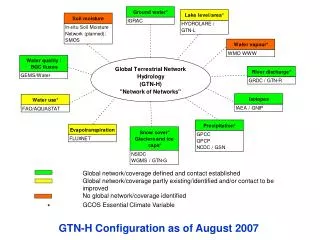
Established in 2001, the Global Terrestrial Network for Hydrology (GTN-H) serves as a comprehensive "network of networks" aimed at enhancing global and regional climate and water applications. GTN-H connects existing hydrological observation systems to provide access to vital data, facilitating research on climate change, environmental monitoring, and effective water resource management. With international partnerships, it focuses on improving communication, data integration, and product development to meet global environmental challenges.

E N D
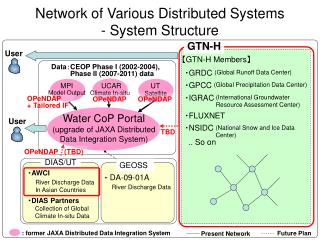
About GTN-H • Links existing networks and systems for integrated observations of the global water cycle • Established in 2001 • “network of networks” for global and regional climate and water applications
Goals of GTN-H • Aims at creating a global hydrological network of networks • Plans and implements projects that facilitate access to hydrological networks and observation data, and generates derived products • Forms an essential component for integrated global and regional hydrological products
Main Objectives • Make available data from existing global hydrological observation networks and enhance their value through integration • Generation of datasets suitable for: • Research in the areas of global and regional climate change • Environmental monitoring, and • Hydrology and water resource management
International Context Joint effort of the: • World Meteorological Organization/Climate and Water Department (WMO/CLW) • Global Climate Observing System (GCOS) • Global Terrestrial Observing System (GTOS) • Observational arm of the Group on Earth Observations/ Integrated Global Water Cycle Observations Theme (GEO/IGWCO)
Selected Achievements • Prototype system for the online near-real time data access to over 400 river gauging stations worldwide • Access to a first global gridded precipitation product • First-time online access to a global water quality database • Prototype definition of a hydrological metadata standard, based on the WMO core metadata standard
Results of the 4th GTN-H Coordination Panel MeetingNew York, 7-10 July 2009 • Improve communication and funding, • Data integration and product development, • Development of demonstration projects intended to highlight the importance of hydrological, hydrometeorological and related observations in various application areas, • Aiming to demonstrate relevance of GTN-H in underpinning adaptation decisions related to climate variability and change and global environmental challenges.
GTN-H Planning Workshop preceding the GTN-H Coordination Panel Meeting • Presenting key examples of progress in the technical, scientific and applications realms that have developed or are using GTN-H relevant data resources, • Recognizing and integrating data provider, data user, and data synthesis perspectives, • Developing an initial vision of short (0-2 year), medium (2-5 year), and longer term (> 5 year) progress.
Request to GTOS • Review the validity of the Global Hierarchical Observing Strategy (GHOST): (http://www.fao.org/gtos/GHOST.html) and propose conceptual and practical ways to integrate with GTN-H observations; • Participate more actively in GTN-H activities including through the joint development of relevant products
Thank you for your attentionContact partners in WMO for GTN-H:wgrabs@wmo.intsbojinski@wmo.int