The Nervous System
This chapter delves into the complexities of the nervous system, detailing its three fundamental functions: sensory input, integration, and motor output. It explores the histology of nervous tissue, emphasizing the roles of neurons and supporting neuroglia. The anatomy of neurons is presented, including dendrites, axons, and synapses, alongside the process of neurotransmission. Additionally, major divisions of the nervous system—Central and Peripheral—are outlined, with a focus on the brain's structure and functional regions, including the cerebral hemispheres, diencephalon, and brain stem.

The Nervous System
E N D
Presentation Transcript
The Nervous System Chapter 9
Functions • sensory input – uses sensory receptors to monitor changes inside and outside body • integration – interprets sensory input and decides what should be done about it • motor output– causes a response by activating muscles or glands • all 3 overlap
Histology of Nervous Tissue • Made mostly of 2 types of cells – • neurons • supporting cells= neurogliaand glialcells
neurons = nerve cells • conduct messages in the form of nerve impulses from one part of the body to another • amiotic* • high metabolic rate
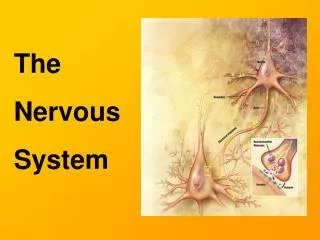
Anatomy of a Neuron • Thecell bodycontains the nucleus and other organelles • Dendrites receive stimuli and conduct impulses towards the cell body • Theaxon carries impulses away from the cell body Cell Body Dendrite Axon
Axon Terminals Direction of impulse • Themyelin sheathis composed of glial cells called Schwann cells and insulate the axon • Nodes of Ranvierare the gaps between neighboring Schwann cells • Axon terminals(terminal buttons) are the ends of the axon Nodes of Ranvier Myelin Sheath
A synapse is the space between a neuron and another cell • presynaptic cell= cell that carries electrical impulses to a synapse • postsynaptic cell= cell that receives the impulse
Neurotransmittersare chemical messengers stored in the axon terminals of presynaptic cells - released into synapse when triggered by an impulse - bind with specific receptor proteins on postsynaptic cell’s dendrite
Classification of Neurons • Sensory neurons/afferent - environment CNS • Motor neurons/efferent- CNS effectors (muscle or gland) • Interneurons/association neurons - most abundant and confined entirely within CNS
Sending a Message • controlled by electrical activity within and between neurons • nerve impulse = series of electrical and chemical changes that travel like a wave over the length of a neuron in response to a stimulus
potential – difference in electrical charge between the inside of neurons and the fluid surrounding them Terms to know: • resting potential (resting state) – inside of the cell is more negatively charged than outside the cell • depolarization – inside becomes less neg.
Action Potentials • do not decrease in strength with distance • Na+ ions move across the nerve membrane and into the cell – this signals more Na+ ions to move as well (depolarization) • A fraction of a second later, K+ ions move out to restore the charge (repolarizataion) • the reversal of charge followed by the return to the resting state is called an action potential (nerve impulse)
refractory period - resting membrane potential is restored before next action potential can occur • action potentials follow the all-or-none principle
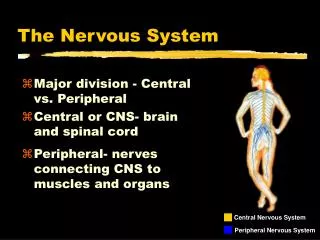
Divisions of the Nervous System 2 Major Divisions: • Central Nervous System(CNS) = the brain and spinal cord • Peripheral Nervous System(PNS) = cranial and spinal nerves
The Central Nervous System • function = serves as integrating and command center • average adult brain ~3-3.5 lb. • complexity of neural wiring more important than size when it comes to intelligence
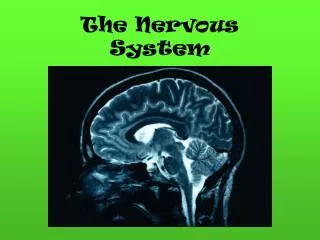
Regions & Organization of Brain • cerebral hemispheres • diencephalon • brain stem • cerebellum
Cerebral Hemispheres • account for 83% of brain mass • covered by elevated ridges (gyri) separated by shallow grooves (sulci) • 2 hemispheres connected by corpus callosum • fissures = deeper grooves that separate large regions of the brain • longitudinal fissure– separates • hemispheres • transverse fissure– separates cerebral hemispheres from • cerebellum
cerebral cortex– 2-4 mm thick gray-matter (neuron cell bodies) that accounts for 40% of brain mass; contains motor, sensory and association areas • cerebral white matter– (myelinated axons) provides communication between cerebral areas
lobes = large regions of the brain • frontal – reasoning, planning, speech, movement & emotions • parietal – movement, orientation, recognition & perception of stimuli • occipital – visual processing • temporal – perception and recognition of auditory stimuli, memory and speech
3 Functional Regions • motor areas: • govern muscular movements (R-L, L-R) • motor speech area = Broca’s area • sensory areas: • interpret impulses from sensory receptors, producing feelings or sensations • cutaneous senses, vision, hearing, taste, smell (also R-L, L-R)
association areas: • concerned with integrative functions -concentration -planning -complex problem solving -judging consequences of behavior -personality traits -intelligence -understanding speech (Wernicke’s area) -choosing words to express thoughts & feelings -reading -memory of visual scenes & music -visual recognition
Other Important Parts of Hemispheres • ventricles – cavities continuous with one another and the spinal cord that contain cerebrospinal fluid
Diencephalon • includes thalamus, hypothalamus and epithalamus • thalamus “inner room” – major relay station for impulses
hypothalamus – caps top of brain stem and pituitary gland attached to bottom • center of emotional response and behavior • regulates body temp, food intake, water balance/thirst, sleep-wake cycle and controls endocrine system functioning
epithalamus • most dorsal portion of diencephalon • connects limbic system (helps control emotions) to other parts of the brain
Brain Stem • composed of midbrain, pons, and medulla • midbrain – contains visual and auditory reflex centers • pons – conduction area; helps regulate respiration and cranial nerves
medulla oblongata– site of fibers crossing over so messages are sent to/from one side of brain to/from opposite side of body • controls blood pressure, HR, rate and depth of breathing • regulates vomiting, hiccupping, swallowing, coughing and sneezing
Cerebellum • Controls coordination and balance by receiving and processing info from visual and equilibrium pathways
Protection of the brain • 3 protective layers (meninges) surround the brain & spinal cord: • dura mater – outer • arachnoid– middle • pia mater – inner
The spinal cord • starts at medulla oblongata through vertebral column ends in sacrum • composed of inner gray matter shaped like a butterfly surrounded by white matter
The Peripheral Nervous System • 2 types of nerves – cranial & spinal • function = serve as communication lines that connect all body parts to CNS • 2 divisions – sensory & motor
cranial nerves – 12 pairs • most are mixed, but some are purely sensory & others are primarily motor • some are somatic, some are autonomic
CRANIAL NERVES • I = olfactory nerves (smell) • II = optic nerves (sight) • III = oculomotor (moves eyeballs) • IV = trochlear (moves the eye) • V = trigeminal (ophthalmic, maxillary, mandibular) • VI = abducens (abducts the eye) • VII = facial (move the face, taste) • VIII = vestibulocochlear (balance, hearing) • IX = glossopharyngeal (tongue & pharynx / swallowing) • X = vagus (“wanderer”: speech, swallowing, heartbeat) • XI = spinal accessory (move neck & back) • XII = hypoglossal (moves the tongue) “On Occasion Our Trusty Truck Acts Funny – Very Good Vehicle AnyHow”
spinal nerves – 31 pairs • named (numbered) for the level from which they arise • 8 cervical nerves • 12 thoracic nerves • 5 lumbar nerves • 5 sacral nerves • 1 coccygeal
each spinal nerve emerges from the spinal cord in 2 roots • dorsal root has an enlargement called the dorsal root ganglion - contains sensory / afferent neurons • ventral root contains motor / efferent neurons • interneuronslocated within the spinal cord connect sensory & motor neurons together
the main portion of spinal nerves combine to form complex networks called plexuses – allows fibers associated with the same part to reach it together • cervical plexus • brachial plexus • lumbosacral plexus
MAJOR NERVES OF THE LEG • Common fibular • Inferior gluteal • Plantar nerve • Sciatic nerve • Superior gluteal • Sural nerve • Tibial nerve
MAJOR NERVES OF THE ARM • Axillary nerve • Musculocutaneous • Median nerve • Radial nerve • Ulnar nerve
a spinal reflex involves nerves and the spinal cord – not the brain • example = the patellar reflex (a stretch reflex) • reflexes are involuntary and typically self-protective
2 Divisions of Motor Division 1) Somatic Nervous System • connect CNS to the skeletal muscles • oversees conscious/voluntary activities
2) Autonomic Nervous System • connects the CNS to viscera(heart, stomach, intestines) and glands • controls unconsciousactivities such as respiration & heartbeat
2 divisions of autonomic NS: 1) sympathetic– “fight or flight” • activated by physical or emotional stress, i.e. emergency situations or being frightened • one major function is shunting blood from one part of the body to another • redirects blood flow from the digestive organs towards the heart & skeletal muscles
2) parasympathetic– maintains homeostasis • brings the body back to normal after “fight or flight” • induces the body to conserve energy
under normal conditions, both the sympathetic and the parasympathetic are activated to some degree