Circulatory System
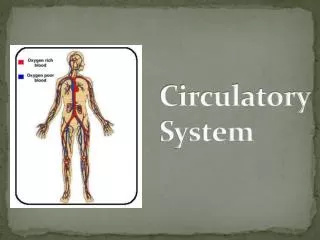
The circulatory system plays a vital role in maintaining homeostasis and providing immunity through blood and lymph. Blood, which constitutes about 8% of the body weight, transports nutrients, oxygen, and hormones while removing metabolic wastes. It consists of formed elements, including red blood cells (RBCs), white blood cells (WBCs), and platelets, all suspended in plasma. Each component serves essential functions, from gas exchange to immune responses. The types of blood groups, blood typing, and the importance of the Rh factor are crucial for safe blood transfusions.

Circulatory System
E N D
Presentation Transcript
Structure & Function Circulatory System includes: Blood & Lymph • Both are tissues • Move throughout the body • Function to maintain homeostasis & give the body immunity
Blood • Hematology – study of blood • Body contains 4 to 5 Liters of blood - makes up about 8% of body’s weight • Functions of blood: - Transports nutrients, oxygen, & hormones - Removes metabolic wastes & carbon dioxide - Provides immunity through antibodies - Maintains body temp & electrolyte balance - Clotting to prevent bleeding from wounds
Blood • Can be divided into solid & liquid portions • Solid parts of blood (formed elements): - Red Blood Cells - White Blood Cells - Platelets (Thrombocytes) • Remaining liquid portion: - Plasma - Buffy coat (mixture of white blood cells & platelets)
Red Blood Cells (Erythrocytes) • More than 25 trillion red blood cells (RBC’s) circulate in the body • Contain a protein called hemoglobin - carries oxygen to all cells - removes carbon dioxide • Each RBC lives 90-120 days - new cells manufactured by red marrow or myeloid tissue in bones - new RBC are made each second (hemopoiesis) - dead RBC’s removed by liver & spleen
White Blood Cells (Leukocytes) • Fight disease and infection • Fewer WBC than red blood cells • Larger than red blood cells • Live about 9 days • Move out of the blood vessels as part of immune process • Pus contains WBC mixed with bacteria
White Blood Cells (Leukocytes) Five types of White Blood Cells: Neutrophils – engulf & digest bacteria in a process called phagocytosis Basophils – contain anticoagulant substance heparin & participate in inflammatory response of body Eosinophils – defend body from allergic reactions & parasitic infections / help remove toxins from blood Lymphocytes – production of antibody & plasma cells & help destroy foreign particles Monocytes – help remove foreign materials & bacteria in process of phagocytosis
Platelets (Thrombocytes) • Smallest blood cells • Produced in red bone marrow • Live about 5 to 9 days • Promote clotting to prevent blood loss • To form a clot: - Platelets combine with prothrombin & calcium to form thrombin - combines with fibrinogen to form gel-like fibrin, which forms the clot
Plasma • Pale yellow liquid left when formed elements are removed from blood • Whole blood is 55% plasma • Plasma is 90% water and approx 10% proteins - proteins help fight infection & assist in clotting • Serum is plasma without clotting proteins - may be used for identification & research of antibodies • Plasma also contains: nutrients, electrolytes, oxygen, enzymes, hormones & waste
Blood Typing • Blood type is inherited characteristic of blood - genes from both parents contribute • Four major blood types: A B AB O • Classified by the presence or absence of antigenic substances on the surface of RBC’s
Blood Typing • Two antigens are A and B A antigen on the RBC = type A blood B antigen on the RBC = type B blood Both A and B antigens = type AB blood Neither are present = type O blood • When an antigen is present on the RBC then the opposite antibody is present in the plasma Type A blood has anti-type-B antibodies Type B blood has anti-type-A antibodies Type AB blood has no antibodies in the plasma Type O blood has both anti-type-A and anti-type-B antibodies in the plasma
Blood Typing AB blood = universal recipient - can receive any type of blood safely because it has no antibodies in the plasma to react with other blood cells O blood = universal donor - can be given safely to a person with any blood type because the blood cells have no antigens to react with antibodies in the plasma of other blood types
Blood Typing • Rh factor: An additional antigen on the surface of RBC • If Rh antigen is present then blood is Rh positive A+ B+ AB+ O+ • If Rh antigen is missing then blood is Rh negative A- B- AB- O- • 85% of Americans have Rh-positive blood
Blood Typing • If Rh-positive blood is given to a person with Rh-negative blood, that person’s blood considers the Rh-positive blood a foreign particle and tries to combat it by forming antibodies • A second transfusion of Rh-positive blood can be fatal to an Rh-negative person • Rh factor also becomes important in the Rh negative mother having a second Rh-positive baby
Page 165 / Figure 11-3 When a Rh- mother delivers an Rh+ baby, some of the baby’s blood may contact the blood of the mother. Mother’s blood then forms antibodies against Rh+ red blood cells. If the mother has another Rh+ pregnancy, her antibodies will attack the baby’s blood