Download
1 / 8
80 likes | 192 Vues
As settlers expanded westward, the U.S. government employed violent measures to confine Native Americans to increasingly smaller reservations. Tribes like the Sioux, Blackfeet, and Cheyenne, known for their exceptional horsemanship, followed the buffalo across the Great Plains, viewing nature as sacred. In contrast, American settlers exploited natural resources for economic gain. This conflict culminated in tragic events such as the Sand Creek Massacre and the Battle of Little Bighorn, leading to forced assimilation through policies like the Dawes Act and the establishment of Indian Schools.

E N D
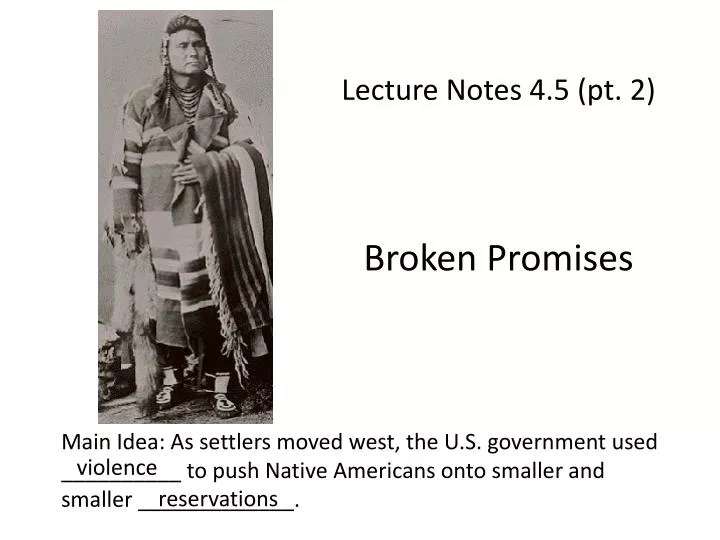
Lecture Notes 4.5 (pt. 2)Broken Promises Main Idea: As settlers moved west, the U.S. government used __________ to push Native Americans onto smaller and smaller _____________. violence reservations
Ways of Life Plains Indians (Sioux, Blackfeet, Crow, Cheyenne, Comanche) • Excellent horsemen and ___________________ • Followed ________________ across the Great Plains • Believed that nature is ________________.
Pushed onto reservations • American settlers believe that nature is a resource that can be ___________ to produce _________________. • U.S. government forces Native Americans onto • Reservations: land “reserved” for ______________________. • Buffalo: white settlers killed them for their hides and for sport until nearly _______________.
War • Sioux begin to _____________________, and the U.S. government __________________ to put down the rebellion. • Sand Creek: U.S. troops __________________ unarmed men, women, and children • Battle of Little Big Horn: 2,000 Sioux Indians led by ________________ meet Col. ________________________ 250 men. • Custer and all of his men are killed. • Wounded Knee: • Dec. 28, 1890: Army rounds up 350 ___________ people • A ________ is fired. The U.S. Army _____________________ Sioux men, women, and children. • It is the end of the ____________________.
Massacre at Wounded Knee Sitting Bull
Forced Assimilation • Dawes Severalty Act: breaks up ________________, assigns land to _______________ Native American families. • “Indian Schools:” Native American children taken to ___________________ where they were forced to dress and speak like ___________. Navajo man Tom Torlino before and after being attending an “Indian school”