Download
1 / 21
220 likes | 340 Vues
This analysis delves into the transformative landscape of family systems in the latter half of the 20th century. It highlights parental influence on children and vice versa, the rise of single adulthood, delayed marriages, and the increase in single-parent families. It also examines the implications of cohabitation, the prevalence of divorce, and shifts towards non-traditional families, including adoption and same-sex partnerships. Understanding these changes is crucial for comprehending their impacts on the modern family structure and child development.

E N D
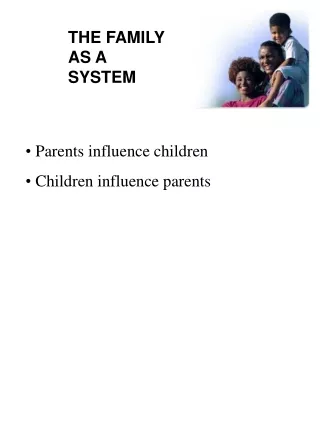
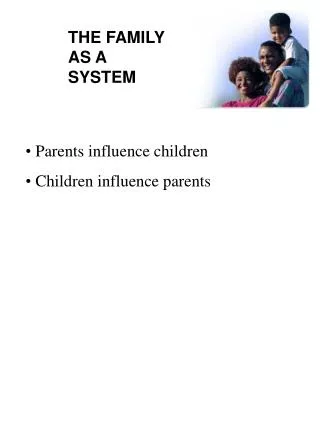
THE FAMILY • AS A • SYSTEM • Parents influence children • Children influence parents
CHANGES IN FAMILY • SYSTEMS • (in the latter half • of this century) • More single adults • Postponement of marriage
CHANGES IN FAMILY • SYSTEMS • (in the latter half • of this century) American Cohabiting Couples by Presence of Children (1960 – 1998)
CHANGES IN FAMILY • SYSTEMS • (in the latter half • of this century) • More single adults • Postponement of marriage • Less childbearing • More females in labor force
CHANGES IN FAMILY • SYSTEMS • (in the latter half • of this century) • More single adults • Postponement of marriage • Less childbearing • More females in labor force • More divorce
CHANGES IN FAMILY • SYSTEMS • (in the latter half • of this century) • More single adults • Postponement of marriage • Less childbearing • More females in labor force • More divorce • More single-parent families
THE FAMILY The single-parent, post divorce family is a common phenomenon of the past two decades; now, however, the number of children living with single parents who never married is almost equal to the number living with single parents who are divorced. In 1970, just 7% of American children in single-parent homes had a never-married parent. Source: U.S. Census data; 1994.
CHANGES IN FAMILY • SYSTEMS • (in the latter half • of this century) • More single adults • Postponement of marriage • Less childbearing • More females in labor force • More divorce • More single-parent families • More children in poverty
CHANGES IN FAMILY • SYSTEMS • (in the latter half • of this century) • More remarriage
SIBLING RELATIONSHIPS • Sibling rivalry • Siblings: • comfort and secure base • role models • teachers • equal-status playmates • managers/caretakers
THE NON-TRADITIONAL FAMILY • Adoption • Gay and Lesbian Families Sexual orientation of adult children raised by lesbian mothers, gay fathers, and single-parent heterosexual mothers. Adapted from Bailey et al., 1995: Golombok & Tasker, 1996.
THE NON-TRADITIONAL FAMILY • Adoption • Gay and Lesbian Families • Divorce • Effects on Children:
THE NON-TRADITIONAL FAMILY • The Effects of Divorce on Children:
THE NON-TRADITIONAL FAMILY • Factors Mediating the Effects of Divorce on Children:
THE NON-TRADITIONAL FAMILY • Adoption • Gay and Lesbian Families • Divorce • Remarriage and Blended Families
THE NON-TRADITIONAL FAMILY • Remarriage and Blended Families • Mother – Stepfather families • Father – Stepmother families • Age and family Constellation • Handout article on abuse & stepfamilies