Updates on WFPC2 Documentation and Data Analysis Techniques (August 15, 2002)
The WFPC2 update from August 15, 2002, provides comprehensive information on the latest documentation, including the Cycle 12 Instrument Handbook (V7.0) and updated data analysis tutorials aimed at novice users. Notable highlights include the status of the anomalous rotational offset for WFPC2 filters, new correction formulas for charge transfer efficiency (CTE), and findings related to the “long vs. short” anomaly. Additionally, users can find improved methods for dithered image registration and contamination rates for various filters.

Updates on WFPC2 Documentation and Data Analysis Techniques (August 15, 2002)
E N D
Presentation Transcript
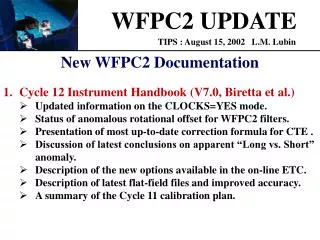
TIPS : August 15, 2002 L.M. Lubin WFPC2 UPDATE New WFPC2 Documentation • Cycle 12 Instrument Handbook (V7.0, Biretta et al.) • Updated information on the CLOCKS=YES mode. • Status of anomalous rotational offset for WFPC2 filters. • Presentation of most up-to-date correction formula for CTE . • Discussion of latest conclusions on apparent “Long vs. Short” anomaly. • Description of the new options available in the on-line ETC. • Description of latest flat-field files and improved accuracy. • A summary of the Cycle 11 calibration plan.
TIPS : August 15, 2002 L.M. Lubin WFPC2 UPDATE New WFPC2 Documentation • 2. Data Analysis Tutorial (V3.0, Gonzaga et al.) • Written for novice WFPC2 users. • Being used as part of new DA training. • Major revisions include : • overview on retrieving WFPC2 data from the archive using StarView • updated examples of useful WFPC2-related IRAF/STSDAS tasks • example of aperture photometry on NGC 2100 using PHOT (including aperture correction, Dolphin’s CTE correction, and conversion from WFPC2 flight to standard magnitudes)
TIPS : August 15, 2002 L.M. Lubin WFPC2 UPDATE Charge Transfer Efficiency for Very Faint Objects and a Reexamination of the Long-vs-Short Problem Whitmore & Heyer WFPC2 ISR 2002-03 • Whitmore, Heyer & Casertano (1999) formula does reasonable job correcting for CTE loss down to extremely low count levels. • Comparison between WHC99 and Dolphin (2000) formula shows reasonable agreement, with D00 giving better results.
TIPS : August 15, 2002 L.M. Lubin WFPC2 UPDATE CTE and Long-vs-Short : WFPC2 ISR 2002-03 Dolphin (2000) Dolphin (2002)
TIPS : August 15, 2002 L.M. Lubin WFPC2 UPDATE CTE and Long-vs-Short : WFPC2 ISR 2002-03 • Long-vs-short effect is very small (a few %) or non-existent for uncrowded fields (<1000 stars/chip), but for crowded fields (~10,000 stars/chip), apparent non-linearities of tens of % are possible, most likely due to an overestimate of the sky measurement in the short exposure.
TIPS : August 15, 2002 L.M. Lubin WFPC2 UPDATE CTE and Long-vs-Short : WFPC2 ISR 2002-03 UNCROWDED FIELD CROWDED FIELD
TIPS : August 15, 2002 L.M. Lubin WFPC2 UPDATE CTE and Long-vs-Short : WFPC2 ISR 2002-03 • Preflashing is useful method of reducing effect of CTE for some observations (i.e. bright objects on faint background), but added noise and longer overheads limit its effectiveness. • Detection thresholds for broad band observations reduced by 0.1-0.2 mag in the ~7 years since WFPC2 was launched, with the worst-case (F336W) being ~ 0.4 mag.
TIPS : August 15, 2002 L.M. Lubin WFPC2 UPDATE New Contamination Rates (McMaster et al.) F160BW, F170W, F218W, F255W, F336W, F439W Comparison between ’97-’98 and ’01-’02 • Slight increase in clean count for UV filters • Decrease of clean count for F255W and redwards • Slowing of rate for filters up to F439W F170W
TIPS : August 15, 2002 L.M. Lubin WFPC2 UPDATE New Contamination Rates (McMaster et al.) F160BW, F170W, F218W, F255W, F336W, F439W SM2 & SM3a F170W
TIPS : August 15, 2002 L.M. Lubin WFPC2 UPDATE New Contamination Rates (McMaster et al.) F160BW, F170W, F218W, F255W, F336W, F439W F439W
TIPS : August 15, 2002 L.M. Lubin WFPC2 UPDATE Dither Working Group Report - MultiDrizzle & PyDrizzle Automatic Registering, Cleaning & Combining of Dithered Images (Koekemoer et al.) • MultiDrizzle is a single, integrated "wrapper" script which uses PyDrizzle, along with other tasks in the dither package, to provide a single integrated approach to cleaning and drizzling dithered images. • Carries out the following steps: • Create bad-pixel masks • Perform sky subtraction • Optionally carry out single-image CR rejection • Drizzle images onto separate output frames • Create a median image from the drizzled images • "Blot" the median back to the frame of each input image • Compare the median and original to identify CR's • Drizzle a final, combined image using the CR masks
TIPS : August 15, 2002 L.M. Lubin WFPC2 UPDATE Dither Working Group Report - MultiDrizzle & PyDrizzle • Refinement of Shifts : • Can refine shifts using catalogs (from Sextractor/DAO-Find) • Automatically creates new cosmic ray masks using improved shifts • Testing currently in progress : • CR rejection • Shift refinement • Median-image creation • Variety of WFPC2 & ACS datasets • STIS & NICMOS to be added next • Prototype version already currently available within Dither Working • Group; will be publicly released as soon as it is stabilized after • testing (approximately in the Fall).