Stoichiometry and Mass Calculations in Chemical Reactions
40 likes | 170 Vues
This quiz covers fundamental stoichiometry concepts, including atomic mass calculations, gram formula mass determination, and mass yield from chemical reactions. Students will calculate the atomic mass of calcium, find the gram formula mass of sodium oxide, and analyze stoichiometric problems involving silver oxide, potassium chlorate, and aluminum reacting with hydrochloric acid. Further, students will explore the synthesis of cisplatin for cancer treatment and the decomposition of sodium chlorate, deepening their understanding of chemical reactions and mass relationships.


Stoichiometry and Mass Calculations in Chemical Reactions
E N D
Presentation Transcript
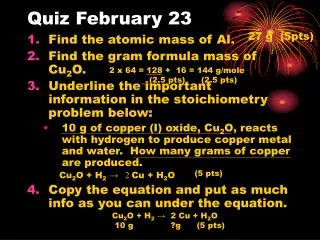
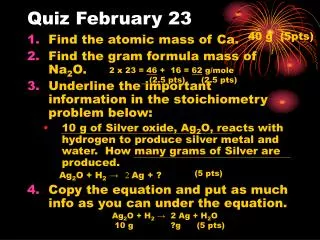
Quiz February 23 40 g (5pts) 2 x 23 = 46 + 16 = 62 g/mole (2.5 pts) (2.5 pts) • Find the atomic mass of Ca. • Find the gram formula mass of Na2O. • Underline the important information in the stoichiometry problem below: • 10 g of Silver oxide, Ag2O, reacts with hydrogen to produce silver metal and water. How many grams of Silver are produced. Ag2O + H2→ 2 Ag + ? • Copy the equation and put as much info as you can under the equation. (5 pts) • Ag2O + H2 → 2 Ag + H2O • 10 g ?g (5 pts)
30. Assume that in the decomposition of potassium chlorate, KClO3, 80.5 g of O2 form. How many grams of potassium chloride the other product forms. 2 2 K+Cl- + O2 2 KClO3 3 3 124 g = ?g 80.5 g 32 g/mole x 74 g/mole K =39 Cl = 35 74g/mole 2.52 mole 1.68 mole
31. In a single displacement reaction, 9.23 g of aluminum react with excess hydrochloric acid. How many grams of hydrogen will be produced? 2 Al + 6 HCl 3 H2 + AlCl3 + Al3+Cl1- 2 2 3 9.23 g ? g = 1.03 g 2 H= 2x1 = 2 27g/mole 2 g/mole 0.34 mole 0.51 mole
Finish the Following for homework #32 p and 59,60 page 245 32. The compound “cisplatin” PtCl2(NH3)2 , has been found to be effective in treating some types of cancer. It can be synthesized using the reaction on page 237 of your book. a) How much “cisplatin” can be produced from 2.50 g PtCl2(NH3)2 and excess NH3. ? b) How much NH3 is needed? 59. In the decomposition of sodium chlorate, 31.7 g of oxygen are formed. How many grams of sodium chloride are produced? NaClO3 -> NaCl + O2 (unbalanced reaction) 60. The action of carbon monoxide on iron (III) oxide can be represented by Fe2O3 + 3 CO -> 2 Fe + 3 CO2. How much carbon monoxide is used if 57.5 g of iron were produced?