Download
1 / 18
180 likes | 295 Vues
This study explores culturally and linguistically diverse (CALD) communities in Sydney, focusing on the City of Sydney and Auburn City Council based on the 2011 Census. It highlights established communities, such as Arabic speakers in Auburn and Cantonese speakers in Sydney, while also identifying emerging groups like Nepali and Thai speakers. The report discusses various data sources, including the Australian Bureau of Statistics and different methods for utilizing census data, as well as the demographic variables affecting these communities.

E N D
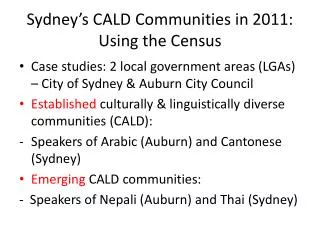
Sydney’s CALD Communities in 2011: Using the Census • Case studies: 2 local government areas (LGAs) – City of Sydney & Auburn City Council • Established culturally & linguistically diverse communities (CALD): • Speakers of Arabic (Auburn) and Cantonese (Sydney) • Emerging CALD communities: - Speakers of Nepali (Auburn) and Thai (Sydney)
Note: Persons who did not state year of arrival were excluded from study Source: ABS (2012a)
Note: Persons who did not state year of arrival were excluded from study Source: ABS (2012a)
Note: Households that did not stated their tenure or landlord type were excluded from study. Source: ABS (2012a)
Note: Individuals that did not stated their tenure or landlord type were excluded from study. Source: ABS (2012a)
Ways to use/peruse ABS Census data • Scales of difficulty: • Beginners: Quickstats, Community Profiles, Aust. Bureau of Statistics (ABS) publications. • Intermediate: Tablebuilder Basic, Tablebuilder Pro • Advanced: Statistical packages (IBM’s SPSS or freeware PSPP), mapping software (MapInfo)
RELATIVE PROPORTIONS: Council areas ranked by their proportion of speakers of languages other than English (LOTE) Source: ABS (2012a)
ABSOLUTE VOLUMES: Council areas ranked according to number of people from non-English speaking backgrounds Source: ABS (2012a)
Year of Arrival in Australia for language groups across Greater Sydney Source: ABS (2012a)
Income – City of Sydney Individual pre-tax income. Low Income: Negative income to $399 per week; Lower-Middle Income: $400 to $999 per week; Upper-Middle Income: $1,000 to $1,499 per week; High income: $1,500 to over $2,000 per week. Note: Individuals that did not state their income were excluded from study. Source: ABS (2012a)
Individual pre-tax income. Low Income: Negative income to $399 per week; Lower-Middle Income: $400 to $999 per week; Upper-Middle Income: $1,000 to $1,499 per week; High income: $1,500 to over $2,000 per week. Note: Individuals that did not state their income were excluded from study. Source: ABS (2012a)
English proficiency – “how well do you speak English?” Source: ABS (2012a)
Alternative approaches to Census research • Different time scale – using Time Series data to describe patterns & trends from 2001-2011. • Different geographic scale – focusing on Sydney/Australia as a whole; using data for mesh blocks/SA1s for information on smaller scale • Other demographic variables: family composition, disability, industry of occupation, method & distance of transport etc.
Limitations to the Census • Incomplete data – prevalence of ‘not stated’ or ‘inadequately described’ in some categories • Subjective interpretation of questions • Suspicion of official data collection & perceived confidentiality issues • Need to request non-English questionnaires • Assumption of honest information
Alternative data sources - DIAC • Continuous Survey of Australia’s Migrants (CSAM): ongoing, surveying every 6 months since April 2009, data available for 2009-2011. • Longitudinal Survey of Immigrants in Australia (LSIA): three cohorts of migrants from 1993-1995, 1999-2000 and 2004-2005 • LSIA 1 & 2 featured humanitarian visa applicants, LSIA 3 & CSAM limited to skilled & family visas • Humanitarian applicants featured in 2011 DIAC commissioned report: Australian Survey Research (2011) Settlement Outcomes of New Arrivals, DIAC: Canberra.
LSIA data for Cohort 1 (1993-94) & Cohort 2 (1999-2000): Reasons for migrating to Australia (more than one reason could be given) Source: Richardson, Miller-Lewis et. al. (2002), p.13.
References • Australian Bureau of Statistics (2012a), ‘Sydney (C)’ and ‘Auburn (C)’, 2011 Census of Population and Housing, tables generated for topics listed below using TableBuilder program, cat. no. 2031.0, accessed August-November 2012, <https://www.censusdata.abs.gov.au/webapi/jsf/login.xhtml> • Language Spoken at Home by Place of Usual Residence • Language Spoken at Home by Age by Place of Usual Residence • Language Spoken at Home by Total Personal Weekly Income by Place of Usual Residence • Language Spoken at Home by English Proficiency by Place of Usual Residence • Language Spoken at Home by Year of Arrival in Australia by Place of Usual Residence • Tenure Type by Place of Usual Residence • Landlord Type by Place of Usual Residence • Australian Bureau of Statistics (2012b), TableBuilder, website, viewed 12 March 2013, <https://www.censusdata.abs.gov.au/webapi/jsf/login.xhtml> • Australian Survey Research (2011) Settlement Outcomes of New Arrivals, DIAC: Canberra. • Richardson, S., Miller-Lewis, L., Ngo, P. and Illsey, D. (2002), The Settlement Experience of Migrants: A comparison of Wave One of LSIA 1 and LSIA 2, DIMIA: Canberra.